Tuesday, October 11, 2011

My Week with Marilyn - Chicago International Film Festival


My Week with Marilyn is a crowd-pleaser if there ever was one. Combining lush production values with a story about two of the 20th century's most famous movie stars, this is an entertaining film that will appeal to a wide audience. I think it's a well made, well-intentioned film to be sure, but one that looks better than it actually plays.

Like last year's Oscar-winning The King's Speech, this film is about a little-known incident involving famous people in Britain. It's based on two books by Colin Clark, who wrote a diary during his time on the production of the 1956 film The Prince and the Showgirl. Laurence Olivier starred and directed that film and fought to have Marilyn Monroe as his co-star. At that juncture, Monroe was at the height of her popularity both for her incredible sexiness as well as her success at the box office.

At that time, Monroe had just married husband number 3, the famed playwright Arthur Miller. He accompanies Marilyn after being cleared of charges that he was a Communist; that allowed him to leave the United States and be there for Marilyn during the filming of her new movie.

However all is not well once production begins. Monroe has her acting coach (Zoe Wanamaker) to help her find her character, as she puts it in the film. This slows things down and Olivier is adamant that Monroe only needs to act, as the "character is on the page." Combine that with her too-often practice of showing up late to the set and Olivier runs out of patience quite soon.


Enter Colin Clark (Eddie Redmayne), a 23-year old from wealth who persevered in his battle to get hired by Laurence Olivier's production company. Clark wanted to show his parents that he could get by on his own and decided to enter the film world (he is shown in his youth early on in the film attending the cinema as a young boy). His job on the production of Prince and the Showgirl isn't much really - only a third assistant director, which was basically a go-fer on the set, but for him, it's an opportunity to work with movie stars.

As Olivier becomes more frustrated with Monroe's lack of professionalism, she becomes more withdrawn and begins to drink and take pills. Her husband can't take her behavior - "she's devouring me"- he tells Olivier and he leaves England to head back home to America to see his children. This only makes Monroe more insecure as well as lonely, so she finally turns to Clark for comfort. She is 30 at this time and Clark is a younger man in a world filled with older men who want to use Marilyn for their purposes.

The friendship that Monroe and Clark is the foundation of this movie. Clark has been dating a young woman from the wardrobe department, but once Marilyn turns to him, he can think of nothing else but this sizzling movie star. One day, they leave the set and the house she is staying at and go for a journey on their own. They do any number of things, from touring Windsor Castle to seeing the campus at Eton to taking a skinny dip in a stream in the woods. This sequence starts out nicely and it certainly is pretty to look at, but by the end, it's just there as a diversion, almost like a travel commercial.


What carries this film are two marvelous performances, that of Michelle Williams as Monroe and Kenneth Branagh as Olivier. It must be a terribly daunting task for any actress to portray the movie's most famous sex goddess who was also a terribly shy and introverted young woman. Williams of course has the looks to take on this role, but she also has the energy and charm to pull of this assignment as well. It is said in the film that when she was right, "you couldn't take your eyes off her." The same can be said of Williams' performance- she's simply wonderful.

While Williams will naturally receive most of the attention for this film, Kenneth Branagh deserves just as much credit. He absolutely has all of Olivier's speech patterns and nervous tics down, but his performance is much more than mimicry. He wonderfully and very subtly captures the great actor's range of emotions toward Monroe, from anger and frustration with her work habits to wonder and envy for her performance on screen. I didn't even recognize Branagh in this role - he simply disappears into the character of Olivier.

High marks also to cinematographer Ben Smithard for his lovely, deeply saturated cinematography, in which he clearly tried to replicate the look of Technicolor in the 1950s (he has succeeded extremely well); he is especially good with the lighting of Williams' face, as he captures the glow of Monroe's aura.

So while this is a pleasing, watchable film, my complaint is that this was made with a big audience as well as multiple Oscar nominations in mind. The film is just a bit too pretty and round, especially with the direction of Simon Curtis who definitely plays it safe. Much of the film is all about recreating scenes from actual life and while that was also the basis of The King's Speech, for me that film had much more of a sense of humor as well as heart.

Maybe the creators of My Week with Marilyn knew they had a winning formula, so they stayed on the straight and narrow. Yes, I like the film, but I wish it had taken a few more detours along the way.


My Week with Marilyn will be shown at the Chicago International Film Festival on Wednesday, October 12 at 8:00 PM. It opens nationally on Friday, November 4.

The Last Rites of Joe May - Chicago Film Festival


You may have met someone like Joe May at one point in your life. He's a helluva guy, but don't tell him that- he thinks he's just a regular fella. He does the right thing, bottom line, even if his actions may get him in trouble. He's also one of the most memorable characters you'll see this year in film and you'll remember him for a long time, thanks to a dazzling performance by Dennis Farina.

The Last Rites of Joe May was written and directed by Joe Maggio, who also performed those tasks for Bitter Feast (2010) and Paper Covers Rock (2008) among others. For Last Rites, Maggio has created a character that we feel for from the start; in his sixties, Joe May is being released from the hospital after a seven-week battle with pneumonia. But apparently Joe forgot to tell his landlord, who thought he either died or moved away, so the landlord has thrown all of Joe's belongings away and has rented his apartment to a single mother named Jenny (Jamie Allman). She's not exactly doing great financially, as we see her pilfer the small orange juice containers that her patients at a nearby hospital don't consume. She's raising a young daughter named Angelina (Meredith Droeger), who never knew her father.

The individual stories of these three slowly start to intertwine, as Joe agrees to share the apartment with Jenny and Angelina, as he will pay part of the rent each month. Now that Joe has a place to stay again, he can go back to his old friends and try make a few extra bucks. He's been a small time crook, fencing watches and radios on the street, but in his heart, he believes he can truly make a lot of money, if only the right situation comes along.

                            Photo by Jay Silver


Meanwhile, we learn that Jenny has a boyfriend who beats her from time to time. When Joe sees him for the first time, he tells him to leave or he'll call the cops. Trouble is, he's a police detective, so there's little that Jenny or Joe can do to stop him. All Joe can do is try and comfort her, but that's not an easy thing for a rough and tumble guy like him. In one scene she asks him if he would hold her, to which Joe replies, "I don't think that's a good idea."

Joe however does start to look after Angelina, tucking her in bed at night and chatting with her at breakfast. She's thrilled to have a father figure in her life and she asks if Joe will have breakfast with her the next morning and the one after that. It's a simple scene, but a critical one in the film and it's one of several moving moments.

There are several factors as to why this film captures our attention from the first frame. Much of the credit goes to Maggio for his script, which has a honest ring to it and is never forced. Every character, from the three major players to the ones with small roles, talk just like you'd expect them to. This is a street drama at its most basic, taking places in the ethnic restaurants, alleyways and neighborhood bars of Chicago and it sounds just right. One other note about the script: Joe May swears a lot in this movie and he'll swear at anyone. It's not for shock value - it's just the way he's talked for most of his life and it's part of this character's charm as well as a good deal of the film's humor. There is one line that Joe May yells at a cabdriver (I won't give it away) that is one of the funniest lines I've heard in a film in years - you may fall out of your seat when you hear it!

The visuals are another reason why this film is so strong, so realistic. I've lived in Chicago my entire life and I love the look of this film. This is not about the lakefront or tall buildings - only the tops of skyscrapers are visible in a couple shots - but rather the snow-covered streets of Halsted Street in winter time. There's a cool, blue tone to the cinematography which fits the visuals perfectly and gives the film a bit of a bleak look. There are several marvelous shots here; the two I loved the most are the #8 bus on Halsted under a viaduct on a windswept snowy evening, while the other has Angelina and Joe swinging a pole around on their roof in order to scatter his pigeons in flight, as they are released from their coops. This last shot is quite hypnotic as well as being lovely to look at; it's also a tender moment between Joe and Angelina, as their affection for each other grows.

I've read, by the way, that Dennis Farina himself had a major influence in having this movie shot in Chicago. The film was originally scheduled to be shot in New York City, but Farina, a native Chicagoan, asked Maggio about doing it in his (Farina's) hometown. Once Maggio and his team scouted out some of Chicago neighborhoods, the decision was made to film in Chicago and a few minor script changes were made.


So a first-rate script and just-right visuals (as well as an impressive bare-bones original score by Lindsay Marcus) are among the strong points of The Last Rites of Joe May, but above all, it is the performance by Dennis Farina as the title character that ties everything together. I've always liked Farina for the honest emotions he displays in his roles - everything about his work has been just right. He looks perfect for the part with his thick grey hair and time-worn face and he finds a nice balance between quiet frustration and explosive bursts of temper. It is quite proper to use the cliché that he was born to play this part, but it's entirely accurate in this case. Dennis Farina is simply great as Joe May and for my money, it's the performance of his career.

Honestly written and acted, The Last Rites of Joe May is primarily a quiet film about a man who only wants to continue doing things as he's always done them. It is a wonderful piece of work and one that I highly recommend.


The Last Rites of Joe May is a Tribeca Film that was the opening presentation at the 2011 Chicago International Film Festival on October 6. It opens in New York City on November 4 and at the Gene Siskel Film Center in Chicago on November 25.


Sunday, October 9, 2011

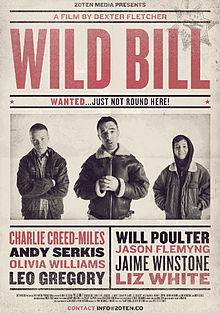
Chicago Film Festival - "Wild Bill" - "The Whisperer in Darkness"

Two capsule reviews of films to play at the Chicago International Film Festival: Wild Bill and The Whisperer in Darkness.


Wild Bill - director: Dexter Fletcher (UK) - This little film has a big heart along with some clever writing, sincere performances and plenty of amusing moments. It may be a little uneven at times, but I think it's entertaining and funny enough to find a good-sized audience.

Set in London's West End, the film is about a character named Bill Hayward, who is being released on parole after serving eight years on drug-related charges. He's got two sons at home, 16 year-old Dean (Will Poulter) and 11 year-old Jimmy (Sammy Williams) who are not exactly warm with their welcome. Their mother abandoned them, so they haven't exactly had a wonderful family life.

Bill doesn't think he has to do much when he returns home, but child support has other ideas. Will Bill turn his life around and create a good environment for his two sons? It turns out he not only has to clean his living quarters, but also win over the love of his older son as well as rid his younger son's drug-running occupation.

Wild Bill is the first film directed by British actor Dexter Fletcher (he also co-wrote the screenplay) and he's chosen a quirky tone, constantly shifting back and forth between the myriad of little stories lived by all the film's characters. It is a bit unsettling at first, but give it a chance, as the major plot lines clear up and the film becomes not only much easier to follow, but also becomes quite funny and charming.

And how can you not like a film with the Eddy Grant song "Do You Feel My Love" playing under the closing credits?

Wild Bill will be shown at the Chicago International Film Festival on Tuesday, October 11 at 8:15 PM and on Wednesday, October 12 at 6:10 PM.

 __________________________________________________


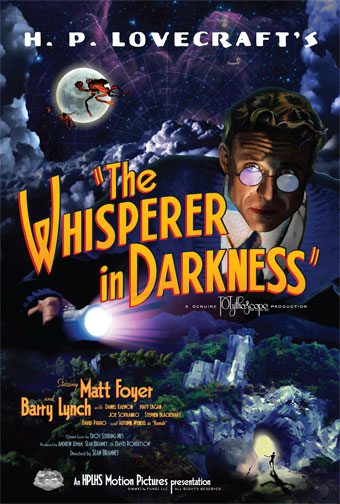
 The Whisperer in Darkness - director: Sean Branney (USA) - Neat poster, eh? Well, this is the only thing I like about this film, which is dreadful on just about every level. 

Based on a 1931 short story by H.P. Lovecraft, Whisperer is about extra terrestrials that have landed on a farm in a small town in Vermont (are there any big towns in Vermont)? The news is reported at a prestigious, but mythical Eastern university named Miskatonic. A folklore professor named Albert Wilmarth (Matt Foyer) doubts this matter, so heads to the farm in Vermont to investigate this situation. Believe it or not, strange things happen once he gets there!

The filmmakers wanted to create the feel of the 1930s horror films here, but they have failed miserably. Hey, just because you film it in black and white, that doesn't mean it has much in common with classics such as Frankenstein or Dracula, two films the creators here clearly love. Everything is thrown in our face and director Branney underlines everything. He really has no concern for the audience's intellect, as he explains everything in his direction - just in case you couldn't figure it out from the overwrought script, co-authored by Branney and Andrew Leman.

The acting across the board is second and third-rate, with the worst performance given by Foyer, who has at most two or three facial expressions; most of the time it's one, a stupid scowl of disapproval. Other actors speak verrrry slowly and often use pregnant pauses when delivering a line, such as "his mail has been... interfered with." It's all overdone - all the time.

Then there's the musical score by Troy Sterling Nies, which is a blatant ripoff of the great Bernard Herrmann, who though best known for his work with Alfred Hitchcock, also wrote some of the finest scores ever composed for sc-fi or horror films (Fahrenheit 451, The Day the Earth Stood Still, et al). I'm sure Nies thinks he's created an hommage here, but his work is not as complex or as clever as Herrmann's. So we get the brooding strings and ominous French horns and cellos that signal danger at many moments in the film. Make that just about every moment in the film, as this is wall-to-wall music that becomes irritating from almost the first frame.

I'm guessing that the filmmakers wanted to create a camp classic with Whisperer, but this isn't entertaining enough to classify as camp. It is instead pompous, poorly executed and lacking in any wit whatsoever. As I had to review this, I watched the entire film, but believe me, there's nothing worth sticking around for- this is a truly bad film.


The Whisperer in Darkness will be shown at the Chicago International Film Festival on Tuesday, October 11 at 10:15 PM and on Wednesday, October 12 at 9:45 PM.


Friday, October 7, 2011

Chicago Film Festival - "Take Me Home"


Over the years, there have been hundreds of films from Hollywood and many other corners of the cinematic globe that have been about two souls that never met, but somehow were meant for each other. Film makers around the world know #1) that opposites attract and #2), audiences love to see stories with this theme.

The latest in this category is Take Me Home, written and directed by Sam Jaeger (one of the stars of the television series Parenthood); he also stars in the movie with his wife Amber. This is a charming work, one that features smart dialogue and down to earth people. It does get a bit cute at times, but overall, this is an enjoyable film that is a worthwhile addition to the collection of the will-they-or-won't-they-get together movies.

The film's premise is a simple one. Thom (Sam Jaeger) has been a bit of a bust in his professional life in New York City and in an effort to make some extra money, drives an unlicensed cab he bought at auction. While that helps his situation a bit, he still can't pay the rent and one day he finds that his landlord has thrown all of his possessions out of the apartment out into the hallway. Sensing that he can't go any lower, he gets in his cab that evening and seeks some fares - and perhaps an answer to his prayers.

At the very moment that Thom is being evicted from his place, Claire (Amber Jaeger), a professional business woman who works for a non-profit organization, has an argument with her husband, whom she suspects of cheating on her. That is only the start of the bad news for her, as she soon receives a phone call informing her that her father in California has suffered a heart attack. Stunned and without any real focus in her life, she heads out of her office down to the street and flags a cab - which, of course, is the one Thom is driving. 

Her request to Thom is simple - drive, don't worry about where, just drive. She can't handle all the bad news at the moment and she needs to be alone with her thoughts. Thom wants to get a handle on her situation, but he knows better, so keeps his mouth shut and does exactly what he's told - he drives. In fact, he drives so far that the next morning, they wind up in the middle of Pennsylvania!


Claire needs to get to California to see her father, but Thom doesn't know why, so when she tells him her proposed destination, he balks at this, until she tells him she will pay him a total of $1000 a day, plus room and board. Thom agrees and it's off on their cross-country tour.

Along the way, Thom and Claire learn about each other and the deceptions in their lives. At first, it's man versus woman, but ultimately as the journey goes sour and they run short on money, they turn to basic survival. One of the most clever sequences takes place when they pull up the cab at the airport in Omaha to pick up fares. They charge one passenger $48 for the adventurous journey to his house, but when he complains that it's normally $25, that's what they accept. They work this scheme for a little while longer and pick up some gas and food money, but they need to move on.

Another scene that works quite well takes place after Claire decides to take over the wheel for one evening. I won't give any plot details away here, but the location at which they wind up is one that forces them to look at who they are, what they are doing and ultimately, what each one is running away from. This is a critical scene in the film that is quite well written and nicely directed.

If there were more scenes such as this, I would have given a strong recommendation to Take Me Home. However, as I mentioned earlier, the film does play cute from time to time, which adds little to the overall qualities of this work. The characters are nicely defined and portrayed, but there are too many predictable scenes, as when they meet Thom's parents. How we meet them is a surprise, but as the scene plays out, it  just doesn't have the uniqueness of other moments in the film.

However, there are enough well-written scenes and enough light comic moments to make the film an enjoyable and pleasant experience. Take Me Home works on the surface level - take Claire home to see her father, but it also is a journey home for both Thom and Claire - who are they trying to be at the end of the day? That, in reality, is a more important journey.


P.S. I also want to applaud Sam Jaeger for resisting the urge to go for cheap humor. Over the past few years, I've seen too many Hollywood films (mostly on planes, which is where they deserve) that seem to want to please only the most base of tastes. These films make fun of people, sometimes in a light manner, but too often in a mean way. I just don't think this shows any sophistication on the part of the filmmakers. 

Sam Jaeger has written a screenplay that respects its characters as well as the meaning of family and friendship. Those emotions will never go out of fashion.


Take Me Home will be shown at the Chicago International Film Festival at 8:00 PM on Saturday, October 8 and at 2:15 on Friday, October 14.


Wednesday, October 5, 2011

Chicago Film Festival - "Miss Bala"


One of the ways in which I judge a film's success is as I'm watching it for the first time, I think to myself that I want to see this work again and I want to see it soon. By that token alone, Miss Bala is a triumph.

I'll have a full review of this film down the road, but a few words for now. Directed by Gerardo Naranjo, this is a devastating look at the drug wars that have been dominant in Mexico over the past decade. The story involves a young woman named Laura Guerrero (Stephanie Sigman) who lives in Tiujana and dreams of winning the local Miss Baja beauty pageant. She enters the competition, wearing the one nice dress she owns and almost instantly her life is turned upside down, when a terrible bloodbath takes place at a local nightclub at which she is present. A few hitmen from a notorious local drug gang go on a shooting spree and Laura is discovered hiding to stay out of the line of fire. From that moment on, her life is forever intertwined with this gang.

I won't go into too many more details at the present, but suffice it to say that Laura's journey is full of shocking twist and turns. Naranjo (who also co-wrote the script) does a masterful job at keeping his camera in tight, letting the viewer experience Laura's nightmare. The director displays a great talent for giving us many details, so the shocking developments of this story are not played for thrills, but rather are integral to the madness Laura must endure.

Miss Bala (which translates as Miss Bullet) is a beautifully crafted work that gives us a moral center - a young woman who only wants to rise above her plain life - in a world that has gone to hell. Narnajo has stated that one of his primary goals with this film was "to create images that would recreate the smell of violence and turn them into an artistic piece, with a keen spirit." He has succeeded brilliantly.


Miss Bala will be shown at the Chicago International Film Festival at 8:00 PM on Saturday, October 8 and at 8:35 PM on Monday, October 10. It will open in New York on Friday, October 14.

A Canana/Fox International Production, Miss Bala has been selected as Mexico's entrant in the Academy Award competition for Best Foreign Language Film.

Tuesday, October 4, 2011

Covering the Chicago International Film Festival


The 47th Chicago International Film Festival opens this Thursday, October 6 and runs through Oct. 20. I've got a media pass and will begin to see my first films of the festival at special media screenings starting on the 5th. 

 There are a number of films I'm looking forward to seeing, most notably A Dangerous Method from David Cronenberg, Into The Abyss from Werner Herzog and The Last Rites of Joe May, shot in Chicago and starring Chicago native Dennis Farina and directed by Joe Maggio.

I'm hearing some great things about several movies at the festival representing many countries around the globe. These include Miss Bala from Mexico, Kid With a Bike (Belgium) and Sleeping Beauty (Australia) to name only three.

There will be a number of filmmakers present during the festival and I'll do my best to interview a director or two. I'm really looking forward to the event with Haskell Wexler, one of the greatest cinematographers to ever work in Hollywood - he won two Academy Awards - and also an influential director, best known for Medium Cool (1968).

I'll get my first post up in a day or two and will update this blog quite often during the next two weeks, as I watch the newest releases from some of the world's finest filmmakers.


Friday, September 23, 2011

The Ups and Downs of Baseball - and Life


Major league baseball players will tell you that over the course of a six-month, 162-game schedule, it is critical for them to maintain an even keel. To get too down over a tough loss or too exultant after a last-inning win is counter productive to a season's success. I think it's important to remember that as you watch Moneyball, a film about the unique journey of a baseball official who tries to achieve success in a very unorthodox manner.

I mention this as Moneyball is not one of those old-fashioned baseball movies where we worry about the last pitch in the bottom of the ninth and whether the home team will be the victors. Now the movie does open with a scene like that, as we see the 2001 Oakland A's try to beat the New York Yankees in the American League Division Series. In that best-of-five matchup, the A's had won the first two games in New York, but them proceeded to lose the next two at home. The climactic game saw the A's take an early lead, but were unable to hold off the Yankees.

An on-screen title tells us one of the main subplots - this was an A's team with a total payroll of 39 million versus 114 million for the Yankees. We then meet Billy Beane (Brad Pitt) the A's general manager in an off-season meeting with his owner, as he pleads for more money to keep the A's competitive with the Yankees and other clubs. He is turned down and is told to find the best players possible with the money they have.

Thus Beane has to reinvent the A's - and himself. He does this by hiring a fresh-faced kid named Peter Brand (nicely played by Jonah Hill) with an economics degree from Yale who has a thing for finding players with the highest OBP (on-base percentage). His reasoning is that the more a player gets on base - even if it is achieved via a base on balls - the better a chance of scoring and of course, the more runs the better the chance of winning.


It's this OPB that is tantamount to a player's value in this new way of rating baseball players and in many cases, it means forgetting their limitations due to age, arm problems or fielding woes. There's a smartly written scene with Beane telling his army of scouts in a meeting in the stadium that their way of thinking is old-fashioned and not what he wants to hear.

Beane and Brand assemble their team according to a complicated formula of statistics and while it would help a bit to be a baseball fan, it's not necessary. At first, the formula doesn't work, as the A's fall six games under .500 after just 46 games. But wait, this is a long season and things can turn around. Of course, as the B&B boys have assembled a team according to their way of thinking, they can only see the true results if these players are in the lineup. And several of them are not, as manager Art Howe (Philip Seymour Hoffman) starts players he believes are better all-around performers. Beane's response to this? Trade those players that Howe starts so he will have to insert Beane's choices in the lineup.

It's this story of how Beane is obsessed with winning with this new approach that is at the heart of the film. There are some great real-game clips from the 2002 season inserted from time to time, but this is not a story of winning and losing, at least as far as the regular season. "If we don't win our last game, it doesn't matter," Beane tells Brand. The championship is something that is out there for only one team in the major leagues and Beane in this film has to live with the fact that although his A's won more than 100 games two seasons in a row (2001 and 2002), they didn't win their opening playoff round, much less the ultimate goal, the World Series.

This is a smart screenplay, written by Aaron Sorkin (Oscar winner for The Social Network) and Steven Zaillian (Oscar winner for Schindler's List), based on the book by Michael Lewis and a story by Stan Chervin. There are some very funny lines, but above all, the screenplay focuses on Beane and his personal drive. There are some nice flashback sequences, as we learn that Beane was a potential superstar who signed a big-league contract with the New York Mets, choosing that over a four year scholarship to Stanford. Beane was supposed to be a no-brainer, a truly great player, but it just didn't work out. Now he's a general manager and surely his mission in his current job is to erase the stigma of a failed career as a player.

Brad Pitt is first-rate as Beane, delivering a passionate, but understated performance. He was nominated for an Academy Award a few years ago for Benjamin Button, but I believe this is a superior performance. He's in almost every scene and it's his facial expressions and subtle delivery that keeps this movie engaging even in the rare off-key moments, where things become a bit too laid back.


Bennett Miller (Capote) directed and has the good sense to not trick things up or get overly sentimental, as the story is a strong one. I did love the way he filmed one game in particular - the one where the 2002 A's were going for the all-time American leagues record of 20 wins in a row. Miller films this partly in reality, with the Oakland crowd cheering wildly for their team and partly in hyper reality, as he shuts off the crowd noises and lets us watch key moments in almost complete silence, with only the soft tones of music by Mychael Danna on the soundtrack (this is a subtle and very effective score). It's an eerie effect and it adds to the bigger meaning of this story.

It's so nice to see a character study in today's era where special effects mean so much, at least in terms of box office. If Moneyball is a success at the turnstiles, it's because the public identifies with someone who realizes that maintaining a vision - even when it's easier to change courses - is what identifies an individual. Don't get too up or too down - just stay the course. Baseball - and life - are long journeys.