Tuesday, February 5, 2013

A Gut-Wrenching Experience


The Impossible, the story of one family's struggle to survive the wrath of the deadly 2004 tsunami that his Southeast Asia, is a gut-wrenching film, one that grabs hold of the viewer from the start and never lets go. It is gripping, highly emotional and a first-rate piece of filmmaking that captures the monstrous power of nature as well as the tender love of humanity.

Directed by Juan Antonio Bayona, the film focuses on the story of a British couple and their three young boys who have traveled to Thailand for the Christmas holidays. Only a few minutes into the movie, the tsunami hits their idyllic oceanside retreat; the recreation of this disaster is stunning in its detail, visual and aural power and emotional punch to the stomach.


At first, the images are quiet; a poolside blender suddenly stops, a wind quietly picks up and blows away a page from a book that Maria (Naomi Watts) is reading, a flock of birds takes wing from nearby palm trees. And then... there is that sound - the sound of doom, of the oncoming wave of destruction. The visuals in recreating the tsunami are amazing, but a great deal of credit also goes to sound designer Oriol Tarrago for his outstanding work, as the sounds as well as the sights of the force of the storm overwhelm us. Especially noteworthy are the sounds of characters gurgling and spitting out water that they have swallowed as the storm carries them on its deadly path. At times with an underwater camera, we cannot see exactly what is happening, which adds to the confusion and terror of the immediate moment so these random sounds only heighten the drama.


There are basically two story lines here; the first (and strongest) is that of Maria and Lucas, who have been joined together in the destruction. She has been severely injured, as her leg has been cut along the storm's path. Lucas, who is terrified, suddenly has to become a man, tending to his mother, as he ultimately leads her to whatever medical help he can find. Holland, who is 16 years of age, is excellent in his role, especially in the scenes in the hospital, where he willingly helps other survivors try to locate their loved ones. His sudden strength is one of the major points of this film, as we learn how the human spirit can triumph over incredibly strong odds.


The other subplot deals with Henry (Ewan MacGregor), who not only has been separated from his wife and oldest son, but also his two youngest sons, Thomas and Simon, who are both under 10 years old. I've admired MacGregor for some time for his naturalistic acting style and he's quite good in this role. He has a much-talked about scene in which he phones a far-away friend and breaks down, sobbing uncontrollably. It works beautifully and in all seriousness, it's one of the most honest scenes I've ever witnessed in a film of a man crying. His fellow survivors in this scene, each desperate to connect with a loved one, feel his pain and we the audience do as well.

There has been a fair amount of criticism regarding the sentimentality of this film. Is it overly sentimental? Well answering that is like asking if someone is "excessively jealous." To borrow a line from the great 1959 courtroom drama Anatomy of a Murder, "what's the norm of jealousy?" If this film is too sentimental in its tone, well that's up to the person watching this work. It is a film that pushes human emotions to the forefront, but I never thought it became maudlin or syrupy.

There have also been some attacks on the makers of this film for not doing enough to show the human loss of this tsunami. Some critics have pointed out that 230,000 people lost their lives in this disaster, yet the film deals only with this family and a few dozen other individuals. I don't know what these critics wanted, as the story of this family (based on the true story of a family from Spain) is quite engrossing. Perhaps the creators of this film should have included a card in the final title sequence honoring the dead; I would have liked that, but I don't think the film suffers because of this omission.

I also want to mention the outstanding work of cinematographer Oscar Faura, whose bright, deeply saturated images at the beginning of this film stand as an ironic contrast to the starkness of the wrecked landscape that we see throughout most of the movie. In between these visual tones, the natural lighting and look of the hospital where many of the survivors are being treated is extremely well done. This is the work of an accomplished cameraman; I would have liked to see him receive an Oscar nomination, but this year as in most years, there are eight or ten films that could get this nod, so it's not necessarily a slight to Faura that he wasn't nominated, but he is certainly someone to take notice of.

I would have also enjoyed seeing composer Fernando Velasquez get a nomination for his marvelous score, but it didn't happen. I think it should have, as this is one of the three of four best scores of the year. It is quite romantic at times, especially in a scene of some of the family members reuniting; perhaps some thought his score was a bit over the top. I don't think this was the case at all, especially when he provides a wonderful cue with nervous strings underlining a scene in which the two young boys are being driven away in a truck with other survivors to who knows where. It's a taut, nervous cue, one that perfectly suits the fractured emotions of the characters (as well as the audience, who want to see a family resolution). The score stands beautifully on its own and let's just say that if John Williams or the late John Barry or Jerry Goldsmith composed this score, they would not only have received an Oscar nomination, but it would have been labeled an "instant classic." (think of the score for Out of Africa by Barry or The Russia House from Goldsmith or Schindler's List from Williams and you'll get an idea of the quality of this musical opus.)


For a film that has received so many positive reviews, it's become a bit unhip lately to praise this film. Well even if that's the case, I don't give a damn. I was moved by this film and I am certain most people will be as well. Congratulations to director J.A. Bayona for making this film the way he wanted to, by highlighting the human emotions that saved this family. One particular sequence that is one of Bayona's best moments occurs near the end of the film when Maria undergoes anesthesia before her surgery; her inner thoughts are on display visually as we see her body float underwater amidst the debris of the storm. At one point, we see the light of the sun from above change this image from that of devastation to one of hope. It's a striking, moving, emotional image that is perfect for this scene and for the overall tone of the film.

You'd have to not own a soul to not be affected in some strong way by The Impossible, especially in the final scene where Maria sees the storm's destruction from above. Watts is perfect in this scene, as she is in just about every moment she is on screen. Her strength is something we can all admire and hope we can display under times of hardship. We may never go through the struggle Maria goes through in this film, but we can identify with her strong will to live. What a lovely message!


Thursday, January 10, 2013

A Masterwork


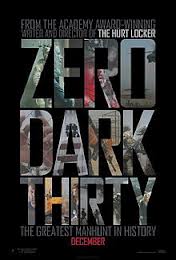
Zero Dark Thirty, the story of the ten year manhunt for Osama Bin Laden is a great, great film. Directed by Kathryn Bigelow and written by Mark Boal, the film is part war movie, part suspense film and part a look at how the world has changed so much since that fateful day of September 11, 2001. This is Bigelow's finest work to date and is a masterwork; it is, in my opinion, the finest film of 2012.

Bigelow, who directed her first feature film in 1982, became an overnight success with her work on The Hurt Locker (2008), for which she won as Oscar as Best Director (the film was also named Best Picture at those same ceremonies). That film centered on an elite Army squad stationed in Iraq, whose job it was to diffuse and disarm bombs in everyday locales.

The focus on that film was more limited, as it dealt with three soldiers on that team and how the dangerous work they were assigned to affected their lives. Both Bigelow and Boal, who also penned the screenplay for Hurt Locker, were careful not to make overt political statements in that film, preferring to present these soldiers as brave men who dealt with incredible risks on an everyday basis. The Hurt Locker was not pro-war, nor was it anti-war - it was pro-soldier. It was also a superb film in which the viewer's heart was pounding throughout most of the action.

Zero Dark Thirty continues Bigelow's and Boal's fascination with the Iraq war, but the canvas here is much broader, as the film's primary subject matter is how the CIA must gather the information to capture Osama Bin Laden, the man who masterminded the terrorist attacks of September 11, 2001. The film opens with a black screen, as we hear noises of cries in the buildings that were destroyed as well as phone calls to loved ones who knew they were going to die that day.


The film's center is a young female agent named Maya (Jessica Chastain). Her first scene has her with a team of agents who are interrogating a low-level member of Al Qaeda. Her superior, Dan (Jason Clarke in a very nice, natural performance) tells this Iraqi that if he is lied to, he will hurt him. He does so, as he begins waterboarding his prisoner in order to make him reveal a name or two. Maya turns away in horror and after Dan momentarily leaves this small cel, tries to comfort the prisoner with a few words.

But Maya - her character is based on one particular agent who has never been identified - is soon immune to these sessions as she becomes more hard-boiled and realizes the importance of her work; she has to come up with names and pieces of information that will lead to the capture of Bin Laden. Her social life is non-existent, as she becomes a workaholic, thriving on the scrutiny of her assignment. She dines in, telling a fellow agent not to eat out, as it's "too dangerous."

It is this single mindedness of her character that eventually makes her stand out in her work and get noticed, in both good and bad ways. She is convinced that one particular member of Al Qaeda - whom she has been told is deceased - is indeed still living and that if she can find him, that will be the key to the CIA's years of effort. Her bosses yell at her, telling her she is crazy and is following a ghost trail, but she perseveres, leading to her new station chief agreeing to let her have the resources she wants for her latest request. Maya looks puzzled, as though this is too easy, but as her boss tells her, "I learned from my predecessor that it's much easier not arguing with you."

What I like about this character is that we're not given some cheap psychology as to why she acts the way she does. We accept that she is lonely and that the love of her work drives her. Clearly, the fact that she's one of the few women assigned to this sort of detail is another key to her behavior. In one of the few comic moments of the film, Maya is the only woman at a high level meeting at CIA headquarters in Langley, VA in which the department head Leon Panetta (nicely portrayed by James Gandolfini) notices her and asks her who she is. Her reply? "I'm the motherfucker who found the house," (referring to the compound where she belives Bin Laden is hiding), is a clear sign that she needs to take on a ballsy attitude if she is to survive in her job.


Maya's dedication and tireless efforts - along with the help of her fellow agents - convince the CIA to argue that the President order the attack on the compound to kill Bin Laden. This is the last thirty minutes of the film and it's white knuckle, edge-of-your-seat time during this extended sequence. A good part of it is filmed in night vision photography, which adds a mysterious, eerie, slightly dangerous edge to an already volatile situation. Of course, we know how this will turn out - Bin Laden is killed - so that makes the suspense in this scene even more impressive. I like how the key moment of the scene is presented, without calling attention to itself; in fact the soldiers who are there are not even certain that the individual they killed is Bin Laden. It becomes a job for these soldiers and while they know the importance of their mission, the tone of this part of the film is not revenge, but merely completing an assignment.

I mentioned that this is Bigelow's finest work so far; I can't say enough about how accomplished her direction of this film is. She never goes to any great lengths to wring the sentiment out of a scene; clearly the emotions and details of the story are dramatic enough. I alluded to her handling of the assault on the compound, but there are two scenes in particular that are of equal quality; one is a recreation of a bombing in a restaurant and the other, the cross cutting between Maya and her fellow agent Jessica (Jennifer Ehle) texting each other about an Iraqi informant whom Jessica is meeting. Maya is in her office, far away from this encounter and we see her anxiously await the next online text from her colleague. It's a tense scene that turns somber and it's a beautiful expression of the devastating emotions arising from sudden loss of life.

I am also greatly impressed with the cinematography of Greig Fraser. Much of the discussion of his work will center on the night vision photography of the assault on the compound, but Fraser's work throughout is stunning. Much of the film is during the day and he uses natural light instead of arc lights, rendering small shafts of sunshine on the faces of the main characters. There's an orange glow in the background of one of the film's final images, as Maya looks to see if the murdered man in the body bag is indeed Bin Laden. The way Fraser lights this combined with Bigelow's (and Fraser's?) classic composition, is a highly moving moment, one that perfectly captures the appropriate mood.

I'd also like to praise Alexandre Desplat for his beautiful score. Desplat has, in my opinion, been the finest composer for films over the past half dozen years; classically trained, his scores have been filled with lovely melodies for full symphonies. But for this work, as is proper, his music is subdued, often very quiet; it serves the film at it should, merely adding a bit of texture and it never announces itself. In fact, you may not even remember the score after you see the film, which is rather high praise, as it never gets in the way. There are numerous composers that can deliver a pretty tune for a film, but few that can write as emotionally well as Desplat.


The film is a superb look at this incident in the recent history of America. While Bigelow and Boal again go out of their way not to make political statements (or to praise or condemn any particular administration), there are disturbing scenes of torture early on in the film. To not show these scenes or to not refer to them would have been dishonest. But the film does not advocate torture and it does not argue that such torture had great effects on the CIA's success in gathering information. Others have claimed it does and this had led to a media firestorm, as early praise of this film has been somewhat tempered. Certainly the snub by the Oscars in not nominating Bigelow as Best Director is more than likely rooted in this aspect. It is unfortunate that this misrepresentation of the film's message has arisen. One wonders if some of the people making these claims even saw the film or if they did, had their minds already made up before they entered the theater. Upon the conclusion of the film, I thought to myself that here was a film everyone could agree upon. Given the constant moaning and groaning in the country, I should have known better.


This controversy aside, this is great filmmaking technically and spiritually. It gives us a character that is a true American at heart, one who will suffer for the sake of the common good. We all felt a terrible blow on 9/11 and this film tells us how dedicated we as Americans are in fighting for what we believe in. We may make mistakes along the way, but in this instance, we succeeded in ridding the world of one of its most evil individuals.


I want to point out that this is not a jingostic film; this is not about the might of America, but about the right of humanity to live without fear. The end credits remember the victims of 9/11 as well as the bombing of the passenger bus in England as well as those who perished in other terrorist attacks. This is a nice touch by the filmmakers and it's clear that Bigelow and Boal remembered these victims as they made this film. For that, they can be proud.


Sunday, December 30, 2012

The Best American Films of 1962

We've reached the end of 2012, so it's high time for me to list my favorite American films from exactly fifty years ago. 1962 was one of the great years in American cinema, remembered by some as the finest since 1939 when works such as Mr. Smith Goes to Washington, The Wizard of Oz, Stagecoach and Gone With the Wind were Hollywood's most celebrated productions. I'll let others argue as to which year was better, but take a look at the films listed below from 1962 - and remember that this is a list of American films from the year, so I'm not including Lawrence of Arabia, the Oscar winner for Best Picture from that year.


1) The Manchurian Candidate - directed by John Frankehheimer - One of two works from Frankenheimer on this list - The Manchurian Candidate, like most great films, stands up to repeated viewings; today the film is as relevant as ever. There are several subplots, each linked to the central theme of brainwashing, as Eleanor Shaw Iselin (brilliantly portrayed by Angela Lansbury) is the American leader of a plot to have her son Raymond Shaw (Laurence Harvey), a Korean war hero, assassinate the leading candidate for President, so her husband, extremist Senator John Iselin (James Gregory) can become leader of the free world and, as one can imagine, lead America down a path of deceit and shame. The brainwashing sequence near the film's beginning where the soldiers have been told they are at a ladies' discussion of gardening, all the while being asked to kill their fellow combatants, is a masterfully directed scene, one that was undeniably chilling in 1962 and still has the power to shock today. A strong message of this film is that the main characters, especially Major Bennett Marco (Frank Sinatra, rarely better) are haunted by their past; given the way that this story plays out, it is clear that they will be haunted for the rest of their lives.


2) To Kill a Mockingbird - directed by Robert Mulligan - One of the most famous and most moving of all American films, Mockingbird is, at its heart, a film about decency, a common theme for Mulligan. The brilliant screenplay, adapted by Horton Foote from Harper Lee's marvelous and wildly successful novel, is a model of efficiency and one filled with emotionally accurate dialogue. While the courtroom sequence in which lawyer Atticus Finch (Gregory Peck in his Oscar-winning role) defends an innocent black man accused of raping a white woman in the Deep South of the 1930s is the most well-known in the film, the scene in which Atticus' children come to his rescue as he is being taunted by his fellow citizens for defending a black man, is just as memorable and as beautifully played out. Especially noteworthy in this scene is how Atticus' young daughter Scout (Mary Badham in one of the greatest child performances ever recorded on film) recognizes the father of one of her classmates and asks, "Don't you remember me?... You brought us some hickory nuts one early morning, remember?" It is this sort of emotional detail combined with Mulligan's sensitive direction and Elmer Bernstein's lyrical and heartfelt score that makes this a classic work of Americana.


3) Advise and Consent - directed by Otto Preminger - Otto Preminger's highly entertaining look at the inside workings of Washington, D.C. politics is a reminder of how little things have changed in our culture (with the exception of the politicians of fifty years ago being a little more polite!) The main story line deals with a nominee for Secretary of State named Robert Leffingwell (Henry Fonda), who is both admired and hated by members of his own party; we follow the process of a congressional hearing and ultimately a Senate vote to learn whether he will be confirmed. Along the way, we marvel at the wonderful characters that populate this story, from the morally strong Majority Leader Robert Munson (Walter Pidgeon) to the cantakerous Seib Cooley, a Southern Democrat who likes to stir the pot to the less than scrupulous Fred Van Acekerman, who is out to see that Leffingwell is confirmed, no matter at what personal harm he may inflict along the way. Following box-office and critical successes with Anatomy of a Murder (1959) and Exodus (1960), Preminger at this time was at a high point in his career; here the use of his camera, floating amidst the Senate chamber is something to marvel at, as is his direction of the final vote, both in terms of space and timing. The outstanding script is by Wendell Mayes, based on the best-selling novel from Allen Drury; Sam Leavitt's black and white photography is documentarian in nature and suits this subject beautifully. Superb ensemble acting as Preminger lets the performers have their moments; thankfully, he sees no need to super charge the film with odd or peculiar images, as the material is strong enough.


4) The Days of Wine and Roses - directed by Blake Edwards - Blake Edwards was most famous for his comedies, as with The Pink Panther films, but this drama is arguably his finest work. The story of how an agreeable businessman Joe Clay (Jack Lemmon) falls heads over heels with an attractive secretary Kirsten Arnesen (Lee Remick) and then turns her on to the lure of alcohol is a descent into hell. Both characters are devastated, but while he admits his problem, she does not. The final scene of the two of them together, as Joe tries to reason with Kirsten into returning to his life, is incredibly heartbreaking and this ending was surely one of the most downbeat in American films up to that time. Both performers are brilliant - Remick was never better - and the scene in the plant nursery where Joe frantically searches for a bottle of bourbon he placed somewhere, is unforgettable in its intensity; it's one of the finest moments for both actor and director. Charles Bickford gives a touching performance as Kirsten's father, another in a long line of great portrayals from this highly underrated performer. Some critics have complained that the troubles of the two main characters are somewhat exaggerated; their reasoning seems to be that instead of just becoming drunks, these two are world-class drunks, teetering on the edge of survival. But honestly, if these two individuals were not as affected as they are, would we really care about them? Would the film be as emotionally shattering? I think not.


5) The Miracle Worker - directed by Arthur Penn - Based on the William Gibson play about Anne Sullivan, the woman that taught Helen Keller how to speak and write, this is a highly absorbing film from Arthur Penn, who had sharpened his directorial teeth in television throughout much of the 1950s. Certainly that training explains his powerful staging of the film's most famous scene in which the two principals struggle with each other in a physical battle over table manners; this nine-minute scene is emotionally exhausting to experience. In many other scenes, simple gestures, such as forming an object with one's fingers, are powerful visuals and it's clear that Penn played up the emotional conflict of the two characters, as Keller strongly resists Sullivan's - or anyone's - search to get closer. Both Anne Bancroft as Sullivan and Patty Duke as Keller, repeating their stage performances, won Academy Awards. Penn's identity as a director who specialized in stories about the individual's inner demons was cemented with this film.


6) Birdman of Alcatraz - directed by John Frankenheimer - This story of inmate Robert Stroud and his groundbreaking work with birds during his decades in prison is a gripping and somber film from Frankenheimer, who directs with great ease and assuredness. While we watch first with great joy and then with sheer awe at how Stroud (Burt Lancaster) cares for the birds in his cel, the other storyline of his relationship with warden Harvey Shoemaker (Karl Malden) is just as absorbing, as Shoemaker hates the idea of a convicted murderer doing anything but prison time, while Stroud only wants to better his world. Everyone remembers the stunning performance of Lancaster, which is clearly among his finest, yet few recall the outstanding work of Malden, who is called upon as a strong combatant to Lancaster. While this film tends to drag a bit toward the end in the scenes of a prison riot, there are so many powerful and poignant moments - as when Stroud tells his wife that he cannot see her anymore - that carry this film to great heights. The stark black and white photography of Burnett Guffey is stunning, as we are given a bleak world of hopelessness. At its core, Birdman of Alcatraz is a tribute to the human spirit and the quality of never giving up, no matter how great the odds.


7) Freud (aka Freud: The Secret Passion) - directed by John Huston - John Huston specialized in films about characters who embarked on a far away adventure; with Freud, that journey is one that takes place within the human psyche. The film focuses on Freud's work with patients suffering from hysteria; at first he works with a colleague, Joseph Breuer, who believes in Freud's theories, while the second half of the film is about Freud's work on his own, especially his treatment of a young woman named Cecily (Susannah York). It is during conversations with her that Freud pieces together his principles of childhood sexuality and repression; this neatly culminates with him sorting out incidents from his own youth and how he reacted to his parents. This is a film that demands a great deal of attention from the audience; one doubts that today's filmgoers would sit through this sincere treatment of Freud's work. Huston's direction is intense, as he brings out the overt meanings of the various dream sequences in beautiful visuals. An excellent, brooding performance by Montgomery Clift as Freud is among the film's highlights as is the subtle, edgy score from the great Jerry Goldsmith.


8) The Man Who Shot Liberty Valance - directed by John Ford - While I don't find this film to be the classic that others do, there is much that I admire about this unusual Western, especially in the duality of its themes of law versus violence. The second half of this film, when attorney Ransom Stoddard (Jimmy Stewart) slowly introduces basic schooling and the principles of democracy to the small town of Shinbone, where guns were always the previous way of settling an argument, is especially strong. The performances throughout are excellent - I particularly love Edmond O'Brien's larger-than-life take as Dutton Peabody, the town's newspaper editor - and the scene late in the film when Tom Donovan (John Wayne) tells Stoddard, "you didn't kill Liberty Valance..." is one of Wayne's finest moments on screen. The line from the penultimate scene, "this is the West, sir. When the legend becomes fact, print the legend," is one of the most famous and devastatingly honest of any American film.


9) Lolita - directed by Stanley Kubrick - It's clear that this version of Vladimir Nabokov novel is not the film that Stanley Kubrick wanted to make - studio censors made certain of that - but this is still a notable work, one filled with great subtleties and marvelous irony. Nabokov adapted his own screenplay and contributed many moments of wonderful dialogue for the four main characters, each of whom is a fascinating, three-dimensional individual. There are some great sexual innuendos - the line about the "cherry pies" being the most famous, but my favorite quote is by Professor Humbert (James Mason) when he tells his wife Charlotte (Shelley Winters), "every game has its rules." It's wonderfully ironic at the time, but that line will carry greater weight as the story proceeds with its numerous encounters. Kubrick's direction is subdued and filled with a sharp eye for the droll humor in numerous sequences; his staging of the scene where Charlotte dances with Humbert in her home is supremely enacted and effortlessly carried out. Though a bit stretched at 152 minutes (the scene with Dr. Zemsh seems like a plot contrivance, while the final explanation of why Lolita left Humbert is rather straightforward in its exposition and not as clever as it should have been), overall, this is a fascinating film. First-rate performances by Mason, Winters (was she ever better?) and Sellers as well as exceptional dreamlike black and white photography by Oswald Morris.


10) Experiment in Terror - directed by Blake Edwards - Like John Frankenheimer, Blake Edwards also had a very successful 1962, most famously with The Days of Wine and Roses (#4, above), but also with this cleverly crafted thriller, which unfortunately is not as well known as it should be. Bank teller Kelly Sherwood (Lee Remick) is grabbed by a crazed man named Red Lynch (Ross Martin) late at night in her garage and told she must abscond with $100,000 from the bank and hand it over to him; if she refuses, he will harm her younger sister Toby (Stefanie Powers). Kelly - as well as we the viewer - cannot see this man's face, so the only thing she can tell the FBI agent John Ripley (Glenn Ford) assigned to her case is that the man has asthmatic breathing; indeed we do not see this man's entire face for the first half of the film, adding to the tension. Edwards and his cinematographer Philip Lathrop create a world of light and shadow in which characters move from the relative safety of their brightly lit surroundings into the unknown dangers of the darkness. There is a constant theme of individuals being trapped in a structure, be it a bank teller's desk, a swimming pool (Toby is being watched there, unbeknownst to her) or within one's residence. Set in San Francisco, the opening and closing sequences - a late night drive across the Bay Bridge and a shootout at Candlestick Park - are eerie and beautifully shot. Henry Mancini contributed a wonderfully creepy score; his opening theme is one of the most spine-chilling ever composed for the cinema.


Honorable mention: Cape Fear (dir. J. Lee Thompson); Lonely are the Brave (dir. David Miller)

Friday, December 21, 2012

Actors on their Craft


"Acting is a masochistic form of exhibitionism. It is not quite the occupation of an adult." - Laurence Olivier


"Films were never in my budget. Didn't occur to me until much later. I hoped for a long, good life, which I've had and I'm having as an actor. I didn't expect the rest." - Peter O'Toole


"At least when you're acting, you can be someone. In front of the camera, you have to be yourself. And who am I?" - Stephen Rea


"I was trained to be an actor, not a star. I was trained to play roles, not deal with fame and agents and lawyers and the press." - Gene Hackman


"I decided to become an actor because I was failing in school and I needed the credits." - Dustin Hoffman


"Actors have bodyguards and entourages not because anybody wants to hurt them - who would want to hurt an actor? - but because they want to get recognized. God forbid someone doesn't recognize them." - James Caan


"Acting is not about being someone different. It's finding the similarity in what is apparently different, then finding myself in there." - Meryl Streep


"Nobody ever became an actor because they had a good childhood." - William H. Macy


"Even as far back as 14 when I started acting, I know I've never considered failure." - Jennifer Lawrence


"People say I make strange choices, but they're not strange for me. My sickness is that I'm fascinated by human behavior, by what's under the surface, by the worlds inside people." - Johnny Depp


"I didn't go out looking for negative characters; I went out looking for people who have a struggle and a fight to tackle. That's what interests me." - Philip Seymour Hoffman


"I think that good actors can do any part. It doesn't mean they are the best ones to do it." - Richard Gere


"Acting should be bigger than life. Scripts should be bigger than life. It should all be bigger than life." - Bette Davis


"I think all those actors from that generation, like Bogart - they were wonderful. They didn't act. They just came on and they did it and they were wonderful." - Anthony Hopkins


"To grasp the full significance of life is the actor's duty, to interpret it is his problem and to express it his dedication." - Marlon Brando


"I kept the same suit for six years and the same dialogue. They just changed the title of the picture and the leading lady." - Robert Mitchum


Wednesday, November 28, 2012

An Honest Look at a Tough Situation


Often the best way to tell a story is honestly and simply. That's the mode in the new documentary Burn, which has opened on a few screens across the country and premieres in Chicago, Washington, D.C., Sterling Heights, MI and Livonia, MI on December 7. This look at the situation of how the fire department in Detroit must deal with any number of crises is sincere in the way it shows this world, serious while never getting overly emotional.

The film deals with one specific crew, that of Engine Company 50, situated in Detroit's impoverished East Side. We are told in the first few minutes of the film that Detroit has more fires that any other city in America; sadly a good number of these fires are set by the city's residents. One fire fighter notes the various ways that individuals do this damage. "There's arson for profit, arson for revenge and arson for kicks."

Other fireman tell of the everyday mess they face in their area. "There are areas that look like bombs have hit" says one fireman; another talks of certain parts of the city looking like "Katrina without the hurricane."

The job of this crew is tough enough - we are given several excellent sequences in which the film crew manages to show us the dangers of their work from only a few feet away - but add to that the fact that the city's budget for the fire department has been squeezed dry. The film makers are smart enough not to hit us over the head with the financial problems in Detroit at the current moment - we know that the automobile industry there is struggling - so we can easily understand it when we are told that there just isn't the money from City Hall to fix aging fire rigs. So the firefighters are working with one hand tied behind their back.

Still, most of them wouldn't trade their lot in life with anyone, as they love what they do. They talk of the brotherhood of the crew, who spend 24 hours a day several times a week with each other. "We're like cowboys in a rodeo," one fireman comments.

One of the subplots of the film deals with a new fire commissioner, a native Detroiter who moved to Los Angeles and performed similar duties in that city. His immediate goal of course, is to trim expenses as well as try and acquire more money for everyday business. One of the ways he aims to do this is a controversial method of letting fires at vacant structures burn out. We're told that there are 80,000 of these structures in Detroit and while the mayor has plans to raze a number of these, there are still tens of thousands of these facilities remaining and the fire crew have to answer the call when they are ablaze.

The new edict seems to make sense - why endanger fire fighters' lives for a vacant building? - but as several crew members point out, you never know if there's someone in that building at any given moment. Indeed we see one fire where that is exactly the situation. Thus the station's crew chief and the commissioner are at odds.

It's a story line like this, where we see that things are not black and white, that help give Burn some added complexity. But to me the best thing about this documentary is the way that co-producers and directors Tom Putnam and Brenna Sanchez honestly deal with their subject. They don't treat the fire crew as heroes, as it too often done these days in television and in the theater. Rather they show them as hard working individuals with a job to do. It's a tough job and we see that in images - we're not pounded over the head with cheap talk. The film never gets overly emotional about its subject, rather it gives us a realistic view of what the world of a Detroit firefighter is all about.

The film is beautifully photographed - kudos to cinematographers Mark Eaton, Nicola Marsh and Matt Pappas - and is briskly paced. This is an engaging, well organized documentary that is a model for how a film like this should be made. Tell us the story, don't wrap it in some sort of fantasy world. By making the fire fighters into real people and not heroes (I'm sure that most fire fighters resent being called heroes), we the audience connect on a more direct level with these individuals. That helps give Burn the proper reality the filmmakers sought to achieve.

Thursday, November 1, 2012

Political Wheeling and Dealing - Preminger Style


Fifty years ago, Otto Preminger treated us to his look at the inside world of Washington, D.C. politics in his mesmerizing version of Advise and Consent. Based upon the wildly successful novel of Allen Drury, Preminger's film remains today one of the most accomplished studies of the inner workings of American politics at the highest level. Varying between numerous narrative tones, from the reality of a congressional hearing to the melodramatics of a senator's homosexual affair from several years in the past, the director assembles all of this material in a highly entertaining film that refuses to take the easy way out.

That should come as no surprise to anyone who admires the work of Preminger, who in 1962 was at the height of his fame as well as directorial powers, fresh off the triumphs of Anatomy of a Murder (1959) and Exodus (1960). While the latter film was a beautifully balanced look at the struggles of a group of individuals surrounding the creation of the state of Israel in 1948, it is the former work that in my mind is Preminger's finest film; a courtroom drama that leaves us with the ending that we, the audience, wanted to see, yet one that left us wondering if justice had indeed been served.

Preminger enjoyed great critical and box-office success with his film adaptations of the blockbuster novels Anatomy and Exodus, so it was no surprise that he continued in this vein for Advise and Consent, which was a publishing phenomenon upon its release in 1959, as author Drury composed a work that was not only an enthralling look at the everyday deeds of our politicians in Washington, D.C (with the emphasis on the Senate); it also became a bit of an enjoyable pursuit, as the reader could imagine the exact senator Drury was writing about. The author was diligent in not naming which senator belonged to which party; this was a smart move, as there were likable as well as less than upright senators on both sides of the aisle in this work. Of course, while there have always been philosophical differences between the Democrats and Republicans, the venom that is spewed forth these days was not so typical in the late 1950s and early '60s.


The device that sets this story in place is a simple one; Robert A. Leffingwell (Henry Fonda), a former head of the Federal Power Commission and now, as this tale begins, the individual in charge of the office of Defense Mobilization, has been nominated by the President (Franchot Tone, in one of the more subuded, self-deflating portrayals of a US president ever put on film) for the job of Secretary of State. We learn of this news in the very first shot, as we see a newsboy holding the morning edition of the local Washington paper with a headline announcing this development (more on newspapers and communication from the early 1960s later in this post).


Senators Seabright Cooley and Robert Munson


We soon meet two of the major protagonists of this tale: Senators Robert Munson (Walter Pidgeon), who is the senior senator of Michigan and also the Majority Leader and Seab (Seabright) Cooley (Charles Laughton), senior senator and self-admitted "curmudgeon" from South Carolina. Munson is a staunch supporter of the President who will do everything in his power to see that Leffingwell is approved. Cooley on the other hand, vehemently opposes Leffingwell and will make speech after speech criticizing the nominee's stand on foreign affairs, claiming he is soft on the threat of communism. Given the political environment in 1962 when this film was released - the Cold War posturing of the governments of the United States and the Soviet Union - this was more than an idle concern. (As a point of reference, this film premiered in June, 1962, only a few months before the Cuban Missile crisis in October of that year).

We are told upfront that these two senators are from the same party, which of course, adds a great deal of inner friction and tension to the proceedings. It also makes for some highly entertaining scenes between the two with some great exchanges (the first-rate screenplay was adapted by Wendell Mayes, who performed a similarly brilliant job on Anatomy of a Murder). After the first session of the committee hearing with Leffingwell is finished, Munson tells Cooley that he has enough votes lined up to see that the nominee will win approval; he asks him, "What do you think of that, you old buzzard?" Cooley's response is wonderful; "Us old buzzards can see a mouse dying from 10,000 feet up. Us old buzzards have the sharpest eyes in creation. Right now, I'm studying the terrain."


The approval hearing is the centerpiece of this film and these sequences are masterfully directed by Preminger, who uses a documentary approach in this section. I love how he gives us a two-shot of Leffingwell and the stenographer; most directors would have given us close-ups of the nominee, probably sweating a bit, perhaps squirming in his seat. That might have been fine, but it would have been a bit clichéd; with this image, the documentary impact - the witness answering questions while the stenographer records his answers - is strengthened. It's the objective approach that is a trademark of Preminger - we aren't given closeups of Leffingwell except for a couple of key answers, so we're not force fed how important his words are; combine that with the minimalist performance of Fonda and you've got the proper emotions that are called for in the scene. I've always admired Preminger for this directorial philosophy and it's in evidence in several other part of the film as well.


Another key element in the scenes of the committee hearing is the outstanding work turned in by Director of Photography Sam Leavitt. The cinematographer did a marvelous job lighting this interior, as we are given vividly sharp black and white images that also have a good deal of grey to them. This is in keeping with the message of this hearing, especially when a small-time clerk named Herbert Gelman (brilliantly portrayed in a nervous, barely audible manner by Burgess Meredith) announces that he knew Leffingwell years earlier when he was a student in one of Leffingwell's classes. Leffingwell says he did not know Gelman when his name is first brought up in the hearing; later on, he states that he did know him. The witness is taking the time-honored approach that hundreds, if not thousands of individuals in his position also took during their cross-examination - admit to nothing. Thus the facts and the accusations - Gelman claims that Leffingwell is a Communist - are not black and white, but interspersed with a lot of grey. (Note: it is a shame that the luster of Leavitt's photography is not evident in these photos, as his work is particularly luminous in these scenes. Do watch the DVD to appreciate the full visual appeal of this film.)

There are numerous twists and turns in this story, as a particularly cunning senator from Wyoming by the name of Fred Van Ackerman (George Grizzard) is out to discredit the committee chairman, Senator Brigham Anderson from Utah (Don Murray), whom he believes is against Leffingwell's approval. I won't go into the details of this subplot, but the consequences play out in the final 15-minute sequence in the Senate chambers, which is supremely directed, written, edited and acted. Preminger uses his crane-mounted camera to swoop in and out of this room, as we see the inner chaos of the final act come to a resolution, as Munson has asked the Senate to advise and consent to the nomination of Leffingwell. There are speeches given, protests raised, a call for yeas and nays on this issue and finally, a taking of the vote. We are given information a little bit at a time, as we learn that the vote is almost even or perhaps one or two in favor of approval; if there is a tie, the vice-president (Lew Ayres) has the tie-breaking vote and will almost assuredly support the nominee and thus his president.

The vice president (Lew Ayres) overseeing the Senate chamber


This sequence is a great finale to this film as we are thrust into the real time of a Senate confrontation. Will the nominee be approved? Will any senators change their mind due to events that took place earlier in the film regarding Senator Anderson who is being blackmailed? This is highly entertaining stuff and it's even more memorable, given the ending we don't expect.

One additional thing worth noting is the ensemble acting of the veteran performers that Preminger assembled for this performance. The director knew that if he wanted a box-office hit when filming a blockbuster (Preminger was a shrewd producer as well as director; his films never ran over budget), he needed to have stars up on the screen that the public not only wanted to see, but also in this case, ones that could be honestly believed in their performances. Of the stellar cast, Henry Fonda was far and away the top star at the time and his brief portrayal of Leffingwell is another throughly professional job from this great actor. Professional is also the word for the performance of Walter Pidgeon, who is the glue that holds this scenario together as the even-tempered Majority Leader.

Then there are the superb supporting performances of Lew Ayres as the vice president (rarely as good as in this role), veteran Franchot Tone as the President, George Grizzard as Senator Van Ackerman, Don Murray as Sen. Anderson and Burgess Meredith as Gelman. Each performance is first-rate and clearly any one of these actors could have been nominated for an Academy Award as Best Supporting Actor. The fact that none of them were - in fact, the film did not receive a single Oscar nomination - is a shame and a bit of an outrage, based partly on the fact that 1962 was a particularly strong year for cinema with the releases of such works as To Kill A Mockingbird, Lawrence of Arabia, The Manchurian CandidateBirdman of Alcatraz, The Miracle Worker and The Days of Wine and Roses among others. Yet one wonders if Preminger's reputation as a tyrannical director had left Academy voters out in the cold. Regardless, the number of accomplished performances in this film is highly notable.


Of course, watching the legendary Charles Laughton dominate the scenery here (as he did so often in his career) is a treat unto itself. Moving his hefty frame across the screen (even standing up and sitting down in his chair in the Senate chamber is an effort), Laughton is having the time of his life as Senator Cooley, a proud, cantankerous fellow whose bark is usually worse than his bite. I love the way he carries himself during the opening of the hearing, interrupting questioning and then making speeches designed to have those in attendance admire him more than the nominee. At times jovial and at times brooding, Laughton is his last film role is brilliant.

Watching this film some 50 years later is a fascinating experience, not only as the film holds up beautifully, but also because of the difference in technology today versus 1962. Thus we watch events in real time, as a Senator has to call someone from his office or hotel room to gain the latest news; he couldn't just take out his cel phone and get in touch on the spot. Newspapers and not electronic media were the main sources for information, so one's opinions were largely based on what a reporter wrote for the public to read the following day. This allows more complexities in the story line and more doubt to creep in among the characters, as everything is not decided in an instant. Preminger lets the action play out in a slightly charged atmosphere; this is a bit of a potboiler, especially in the final sequence, but it's remarkable in its look at both the rules as well as the wrong doings of the game, the game being politics, the biggest in the town of Washington, D.C.

Thursday, October 25, 2012

Perilous Threads


In Argo, the latest film from director Ben Affleck, the lives of six people are literally defined by pieces of paper. These include fake passports, disembarcation cards, phony resumés and most hauntingly, scraps of shredded paper. It is this fragile balance that gives this true story its power and immediacy, as we watch this knowing that any of these six people could be our co-workers, friends or even ourselves. More than a recreation of an historical event, Argo asks the viewer to understand how so many things had to go right for these people to survive; government agencies may have power to take action, but in the final analysis, those logistics depend on brave people carrying them out.

Argo is based upon the famous incident in November, 1979 when more than fifty employees of the American embassy in Tehran, Iran were captured and taken as hostage. The people responsible for this act did so as a form of protest regarding the United States offering asylum to the Shah of Iran, who had been recently overthrown. President Jimmy Carter, seeing that the Shah was in poor health, allowed him to come to American to spend his final days.

Affleck begins the film with a brief history of Iran - shown as comic book frames - starting from centuries prior all the way up to the point in 1979 when the Ayatollah Khomeini took charge of his country. The film immediately puts us in harm's way, as we are there at the embassy grounds seeing how the everyday business of granting visas is juxtaposed with the angry mob storming the gates, desperate to get in and create a scene. They succeed in breaking down the barriers and entering the building at various positions and while the embassy troops do what they can to fight off the mob with tear gas, they are hopelessly outnumbered; the employees are taken as hostage.

Amidst this chaos, six employees escape via a side entrance and hurry along local streets, fearing for their safety. They quickly come upon the residence of Canadian ambassador Ken Taylor (Victor Garber), who lets them into his home. As long as they stay in his house, they are safe - or at least until the Iranian police squads can find them.


The Central Intelligence Agency immediately learns of these six and realizes they must be rescued before they are discovered, but how? One of the most powerful agents at the Virginia headquarters calls in Tony Mendez (Affleck in full beard), an "exfiltration" agent who had successfully led previous rescue missions overseas. Mendez explains the risks involved to the agency heads, but can't come up with a plan until he is inspired by a science fiction movie he watches on tv. His solution? He will create new identities for these six, who will now become employees of a film production company from Canada who are in Iran to shoot a futuristic epic.

While the agency bosses are initially leery of such a plan ("Don't you have a better bad idea?," asks one of the agents), Mendez eventually convinces them that this is their only alternative. Of course, to convince anyone that the six "Canadians" are truly there to make a movie, he has to create one. He meets with John Chambers (John Goodman), an Oscar-winning makeup artist as well as a former CIA agent and down and out producer Lester Siegel (Alan Arkin, who is hilarious) to come up with the film, screenplay and production company. Their choice is a ridiculous Star Wars-inspired adventure entitled Argo, which everyone admits will be a pretty cheesy film.

The three of them do their job brilliantly, even convincing Variety, the Hollywood show-biz Bible, to run a story about the film's upcoming production. One of the best sequences in the movie is a read through of the script at a lavish party, as the film's performers, garbed in ridiculously absurd costumes, act out their parts. Just to remind us how phony this world is, Affleck then intercuts to a scene of the captured hostages being hooded and led to the embassy basement where they face Iranian soldiers who fire their empty weapons at them - just to see the fear in the Americans. It's a brief, but chilling moment that displays the insanity - or absurdity, if you will - of this entire situation.


Affleck does an excellent job presenting this various layers of this story; things start to get quite tense once his character arrives in Iran and meets with the six in their hideout. A few are reluctant to go along with this plan, fearing it will be instant suicide, but eventually they realize they must act as a team. The scene where Mendez takes them through the streets of Tehran, as they are supposedly scouting possible locations for their film, is beautifully directed by Affleck, as we see the anxiety on the faces and in the body language of these six; there's a nice piece of business when Mendez has to tell one of them that he's looking through the wrong end of a viewfinder. As they walk along a busy avenue amidst a huge throng of locals carrying on their everyday business, they cannot help but feel they are being watched; this sequence is nicely staged and directed with just the right feel.


In his two previous directorial efforts, Gone Baby Gone (2007) and The Town (2010), Affleck displayed impressive talent, especially in terms of atmosphere as well as timing; he presented the action in these films in a manner that was not rushed, letting his actors have their moments. His cutting was quite notable on the latter film, especially in the opening and closing robbery scenes. Now with Argo, Affleck does an even better job with cross cutting, especially toward the end of the film where we go back and forth between the plight of the six at the airport as they wait upon customs and security to let them board their flight and C.I.A. headquarters where split second decisions must be made by a few agents if this mission is to succeed. This is a classically structured sequence, as we're on the edge of our seat waiting to learn the protagonists's plight. One can finally take a deep breath once this action is played out.

With Argo, Affleck has taken his next step as a director, capturing the power of images. I wrote at the start of this post about pieces of paper being a literal factor in the lives of the six. The most unforgettable image in this film is that of Iranian children huddled in a room assembling shredded documents that when assembled properly will identify these escapees; the fact that the Iranians could go to such lengths is a sign of the ruthlessness in which they went about their deeds. These long, thin pieces of paper are flimsy, yet also very powerful when fit together. Contrast that with the story boards of the phony film that Affleck carries with him to convince the Iranians that his production company will make their fantasy/adventure film and you realize how people's lives can be saved or destroyed by a mere document. It's a chilling message.