Thoughts on meaningful cinema - old and new - from an avid film devotee. Tributes to directors, composers, cinematographers and other craftsmen. - Tom Hyland
Tuesday, October 27, 2015
Kent Jones on Hitchock
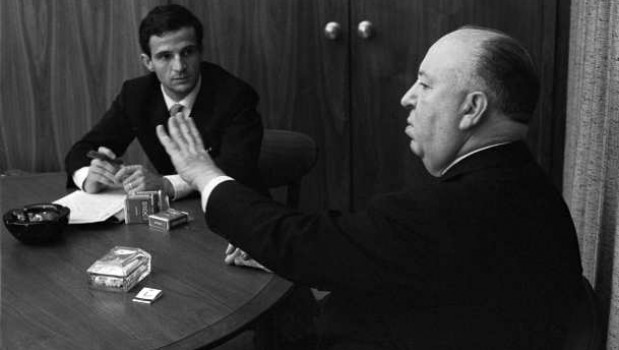
Prominent film critic Kent Jones was in Chicago this past weekend for a screening of his new documentary Hitchcock/Truffaut, which was shown at the 51st Chicago International Film Festival. The film, which opens in theaters in early December is brilliant, a superb look not only at the details of the famous interview in 1962 between Alfred Hitchcock and French director François Truffaut, but also an examination of several scenes from Hitchcock's finest works, as analyzed by such notable current film directors such as Martin Scorsese, Wes Anderson, David Fincher, Arnaud Desplechin and several others.
Per agreement with the film's distributor, I cannot post my full review until the film's theatrical release, but I was able to conduct a brief phone interview with Jones. While technical issues on my end precluded me from transcribing the entire interview, I can give you some highlights.
I mentioned to Jones that I thoroughly enjoyed the musical score by composer Jeremiah Bornfield; subtle, quiet and edgy, the music recalls the spirit of Bernard Herrmann's finest work for Hitchcock without ever borrowing from it.
"That's interesting, " Jones commented, after thanking me. "We purposely didn't want a Herrmann-like score for this film. I was looking for something like what Johnny Greenwood wrote for There Will Be Blood. "But I'm extremely pleased with Bornfield's score."
I asked Jones, about his beginnings in film- did he go to film school? "I did, but I didn't stay very long- film school and I weren't meant to be," he replied. He mentioned, however, that he was stirred on by the tv documentary series in the 1970s, The Men Who Made the Movies, produced by film critic Richard Schickel. "It influenced me greatly," he told me. "I discovered there was such a thing as a director and an editor."
I asked Jones, who has just turned 55, about his first viewing of a Hitchcock film. "It was a 2-D print of Dial M for Murder," he replied, which he saw in college. Later on, his mother took him to see old prints of such Hitchock classics as The 39 Steps and Psycho.
In Hitchcock/Truffaut, there is a sequence in which Martin Scorsese describes one particular shot in the film Topaz (1969), in which a character turns his head a little to answer a question. Scorsese points out the slightly overhead angle of the camera so that we, the audience, can see this person's eyes faintly shift; for Scorsese, this shot tells us that we know the character is lying. It's a remarkable piece of analysis by Scorsese and of course, a marvelous, subtle piece of directing by Hitchcock.
I asked Jones if he thought that any evaluation such as this was being taught in film schools today. "I can assure you that it is not being taught in film schools," was his reply. I mentioned that this sort of analysis was not something the average film goer would pick up on. Jones agreed, but added, that Hitchcock, "was doing something that wasn't going to be noticed. It's just a fabric of what he was trying to achieve." Excellent scrutiny by Jones, as well!
I also asked Jones if he interviewed everyone he wanted to for commentary in this film. He said basically he did, except for Brian de Palma, whom he had asked, but opted to decline, as there is a new documentary coming out about him; thus de Palma was reserving his comments. When I asked Jones as to why he didn't talk to Mexican director Guillermo del Toro, who has written at length about Hitchcock's films, Jones basically told me that del Toro's work is in print for anyone to read.
Jones concluded the interview by stating that he is not into the idea of Hitchcock's perversity, as was suggested by critic Donald Spoto in one of his books (written, incidentally, after Hitchcock had passed away.) "There is so much moralizing throughout the culture today," Jones stated. "People love to point the finger." He continued on this topic by saying that "these conversations about women - they're not real issues in the film."
Clearly, Kent Jones admires the art of Alfred Hitchcock; his documentary is solid proof of that. It's also arguably the finest film ever about the great director. I highly recommend it - congratulations, Kent!
Friday, October 23, 2015
The Man Behind the "Madnesses"
Jeremy Carr (Photo ©Tom Hyland)
Writer/director Jeremy Carr was in town recently for a showing of his first feature film Other Madnesses, which was screened at the 51st Chicago International Film Festival. The film is the story of a New York City tour guide named Ed Zimmer (James Moles) who may or may not be imagining evil deeds taking place in the immediate world around him. Reminiscent in some ways to Taxi Driver, this is a highly effective film about an individual and his private hell, stylishly directed by Carr.
I sat down with him for a one-on-one interview to learn about his experience in the movie business, the realities of making this movie and if he was influenced by the film Taxi Driver, when he made this work.
Tom Hyland: Are you from New York?
Jeremy Carr: I grew up in New Jersey, the town of Westfield, nearby New York City.
I went to school at Boston University and attended film school there.
Afterwards I moved to New York City, thinking this was going to be temporary, this will
be a pit stop on my way to Los Angeles and I ended up staying in New York for
sixteen years.
It’s just something that happened. It’s like New York has a way of
pulling you in and keeping you there.
TH: What did you do for 16 years in New York?
JC: Initially I came out of film school and I wanted to keep
making films. In school, I had made several short films. At this point, I was
shooting a film in 16mm and came out of film school and the reality was that I
had to get a job, so my first job was at Miramax. I started out as a temp at
Miramax and worked my way into a job in their post-production department. So it
gave me a sense of what was going on in the industry and how a film company
actually works. It allowed me to meet a lot of interesting filmmakers.
TH: Is that still owned by the Weinsteins? They now have their
own company, right?
JC: Right. I believe the Weinsteins sold it. I think there is
new ownership.
TH: The question that I’m sure you have been asked a lot and
will be asked a lot is “were you influenced by Taxi Driver when you made this film?” Tell me about this film. Is
any part of this autobiographical? What about the main character Ed? Is he
based on anyone you know or is he a composite of people?
JC: Sure. The impetus for the story came from my own
experiences. I lived in New York City for sixteen years and at that point, I had been
living there about eight years. It was a combination of things. One, was I kept
a journal and I would write down anecdotes about things I observed in the city.
Usually bizarre things, things that I thought were strange or surreal, or
creepy. I would collect those little anecdotes.
At the same time, I was going through a period in my life
where I was having really bad recurring nightmares. So I started researching
lucid dreaming, how to use lucid dreaming to overcome nightmares, which was a
technique that I picked up from a book called On Lucid Dreaming by Stephen LaBerge. It actually really helped me.
It helped me figure out how to become aware and conscious while I was dreaming,
and I was able to stop the bad dreams from happening.
TH: Did the dreams start in New York?
JC: Yes. Mostly I think it had to do with my general state of
paranoia of living in the city, surrounded by people all the time. Coming close
to getting mugged a couple of times. Mostly having these dangerous moments that
I compiled, but I worked through it using this dream therapy.
That’s when I started writing the screenplay. I had this
idea for a character not like me, necessarily, but going through a similar
thing I was going through, having recurring dreams and wondering what that
means. I wanted to take it to the extreme level of what if you started to think
your dreams were more than fantasies, what if they actualy signified something?
What if you had a character that was becoming unhinged and thinking that the
dreams were premonitions and were somehow important to his life, and they were
like puzzles and he needed to understand them, what they mean and what to do
about them.
So that’s where I started from and your question is about Taxi Driver. I consider myself a bit of
a cinephile and I do watch a lot of films and I went to film school and I
certainly love that movie. I would say I wasn’t super conscious… it wasn’t as
though I was writing an updated version. I felt like I thought I had a good
first draft of the script, I remember having a moment where I questioned, “is
this too much like Taxi Driver? Am I doing anything new? Is there anything new
I am bringing to the table?
What I decided what I really liked about the story was that
it did have sort of a nod to Taxi Driver,
but it felt more contemporary. The character felt different to me. The
character of Ed, unlike Travis Bickle, who was a Vietnam vet, Ed Zimmer is
college educated, he’s sort of a college dropout. But in the movie, I like this
idea of being a more educated and post-9/11 Travis Bickle, if that makes sense.
And that puts a new spin on it and obviously, once we
started filming, you start pointing the camera and you find really interesting
locations in New York City in all five boroughs. What I wanted to do was
contrast, thing such as Times Square, the Statue of Liberty and all the iconic
landmarks of NYC and contrast that with the seedier moments you might find in
the Bronx or in Brooklyn or in Staten Island. Once you start doing that and
point the camera at those places, you can’t help but feel, is this the Taxi
Driver vibe?
TH: I like the idea of having Ed be a tour guide on a bus, so
he’s everyman, so those fears and nightmares become more real. Also the fact
that he’s seen all of the city, he’s seen all the sickness; he’s not some
advertising agent working in an office on Madison Avenue.
JC: Right, well, he’s seen both sides that the tourists aren’t
seeing. And it’s through the eyes of a tour guide that he spends all day
talking to tourists, saying, “on your left is the Empire State Building and he
says “New York City is the greatest city on earth” and he repeats it as it’s a
mantra. “The greatest city on earth. The greatest city on earth.”
And then we see him go home at night. It’s anything but the
greatest city.
TH: I like how you use space, as you have that cramped
apartment where Ed can barely think as opposed to the skyscrapers of Manhattan,
although there is a certain claustrophobic effect to that as well.
It is, and NY has so many interesting locations. What I
tried to do was to frame each scene to be a reflection of Ed’s state of mind.
In large part, it’s a story about loneliness and the lonelieness of living in a
big city such as New York. And even though you’re surrounded by people, sometimes
it’s the loneliest place to be, because you’re anonymous and they’re strangers.
I wanted to show that element that Ed lives in.
TH: I love the opening shot as well, with the lightbulb flickering
in the dark apartment. It sets the tone for the film perfectly. Now when you’re
making this film, how are you hiring these actors? Are these people you had
known or were they recommended to you or did you work with a casting director?
JC: To backtrack a little bit, this is a truly independent
movie. Very small crew. Dawn Fidrick and I produced it together. It took us
eight years essentially from beginning to end. We shot for six years in the
city and we did put out ads. Six years, as people’s schedules would allow us,
as we would raise finds and shoot when we could. Then we would work day jobs.
One of the trickiest parts was keeping the continuity
straight. James (Moles, who plays Ed) was great at that, keeping his hair a
certain length. The basic part was his acting, becoming that character again
and again. Not only sustain that role for that long period of time, but we were
shooting out of order – you don’t shoot in continuity. We would talk about it a
lot when we were preparing to do a scene. He had a real knack for keeping in
mind where his character was on the arc. For example, his character is a
different personality by the end of the movie that he was at the beginning of
the movie and there’s a whole range in between. I give him credit. I didn’t know if he could do it, but James could pinpoint where he was in that spectrum. He
would ask me to remind him where that scene falls in the story so he could know
emotionally where to be at that point.
He comes from the theater, which really helps. His background
is a stage actor, so I think for him, doing that sort of mental preparation. He
likes to rehearse a lot and work on a scene.
TH: I thought that Natia Dune, who plays Lucya, was great. How
did you happen to hire her?
James had become a friend by this point, as I had seen him
do some theater work. To answer your previous question, Ed Zimmer is an amalgam
of different people, James a little bit, maybe myself a little bit. Also Crime and Punishment plays into the
story, so I wanted that Raskolnikov in the character, that sort of paranoid
Russian character and then I’ve done tons of research on true crime. It’s
something I’m fascinated with. This sort of ties in more with the kilers in the
story. Researching from everyone from Ted Bundy to Jeffrey Dahmer, pulling from
their personalities.
But Natia Dune is someone I met from doing auditions. I
auditioned 200, 300 actresses and she just rose to the top.
Jeremy Carr (Photo ©Tom Hyland)
TH: As far as Ilya Slovesnik who plays the stranger, how did that
character come about?
JC: That ties in with the Crime and Punishment angle. As you
know, Ed becomes obssessed with reading the book Crime and Punishment. When I was writing the script, I was sort of
obsessesd with Crime and Punishment
and that’s how it came into the story.
I had this idea that when Ed is reading Crime and Punishment
he would be also walking around Times Square observing things. He sees a
prostitute working on a street corner. He sees a sign in the window that says,
‘just one buck.’ All these little things that are clues to what’s going to
happen later. The film is very subtle.
It all kind of works together. In a way that he’s connecting
things and elements of Crime and
Punishment keep resurfacing in real life.
And one of the things… this character called the Insepctor
that Ilya Slovesnik played.. when I was writing it, my approach to
writing the script was that I didn’t want to follow the standard three-act
structure, like the old way of writing screenplays. Not that there’s anything
wrong with that, but I wanted to take a more novelistic approach to it. So let
me start with this character and the dilemnas he’s having and the nightmares
he’s having and doesn’t know what to do about them and let me just follow him
around and see what he does.
So the story begins with that problem and we just follow Ed
on a strange journey that just sort of meanders about. I wanted it to feel more
realistic. I kept asking myself.. I didn’t want this to be a genre, horror type
movie in the sense of having things jumping out at you to scare you. I didn’t
want to fall into those tracks. I wanted it to be more character driven than
that.
That’s how I got to the third act. I felt like we needed to
turn the pressure up a little bit. We need to have a reason why Ed would
abandon this vigliante mission he is on. I felt that the cliché would to be to
intrdocue this cop character, somebody that is trying to capture him. I felt it
would be much more interesting to have a stranger, this mysterious character
turned up and statred talking to him and stalking him. And we don’t really know
who he is and Ed doesn’t know who he is. And it would feel as though he stepped
right out of the pages of Crime and
Punishment.
Again, it ties in with this idea that Ed might be imagining
this and might not be – it might be real, it might not be real.
TH: You seem like a confident person, but were there ever
moments of doubt over the years you took to make this?
Oh, there were definite dire moments, but time was on our
side. There was no real deadline for the film. The only deadline was would the
actors stick around?
JC: Time was on our side and it also allowed me to have more
creative control. We had a studio in Brooklyn and we built the sets in there.
We could pre-light the sets, film a rehearsal of a scene and then take that
film to edit it and look at what was working, to be able to test it out. It
became a really interesting process of crafting and refining the film.
Monday, October 12, 2015
Chicago International Film Festival 51 - Initial Thoughts
Chicago International Film Festival 51 - opens this week!
The longest running international competitive film festival in the United States returns for its 51st edition, starting this week in Chicago. Opening night is Thursday, October 15 with the screening of the Italian film Mia Madre, directed by Nanni Moretti.
I have seen this film and will review it soon. Here are notes on the first three films I have seen from this year's festival:
Breakfast at Ina's - directed by Mercedes Kane. This is an uncomplicated documentary about a lovely woman, Ina Pinkney, who managed Ina's, a breakfast restaurant in Chicago's West Loop, that became a local institution. The film covers the action of the final month - December 2013 - of the restaurant, which Pinkney was forced to close due to her health; she contracted polio in her youth and still suffers today from post-polio, as she has trouble walking.
If this film is not as gripping as it should be, it is a very good and even-keeled look at Pinkney's life, which has had many ups and downs. The most engrossing part of this documentary has to do with Pinkney recalling her marriage in the 1960s to a black man; interracial marriage of course, being somewhat of a taboo at that time. Clearly, Pinkney's experience with this matter, both in Brooklyn where she lived at the time and soon after, when she moved to Chicago, shaped some of her outlook on life.
This is a film with a good heart, as it keeps things simple, offering us Pinkney talking about her management style, the everyday travails of running a breakfast restaurant and her future. She comes across as one of the most genuine people you'll ever meet.
Breakfast at Ina's will be shown on Sunday, October 18 at 3:30 PM; Thursday, October 22 at 12:00 PM and on Friday, October 23 at 4:00 PM
___
How to Win Enemies - directed by Gabriel Lichtmann. The less said about this film, the better. This is a movie for the Facebook crowd, as the characters are two-dimensional at best, the actors are all young and look beautiful, the lighting is bright, with saturated images, and worst of all, a silly story with a puzzle. The puzzle has to do with one of the main characters being robbed of a good deal of money, but we never believe for a second that his life will be all that difficult. While the dialogue isn't embarrassing, neither is it particularly clever and it adds up to very little. This isn't a disaster, as it's moderately watchable, but there isn't much substance, style or wit to this very short (78 minutes only, thankfully) film from Argentina.
How to Win Enemies will be shown on Wednesday, October 21 at 5:45; Thursday, October 22 at 9:30 PM and Monday, October 26 at 2:45 PM.
___
Other Madnesses - directed by Jeremy Carr. Much more ambitious than the previous two films I discussed, this is a harrowing look at an everyday citizen of New York City and how he views the horrors of the city. That makes Other Madnesses sort of an alternative version of Taxi Driver; clearly Carr was influenced by that seminal film when he made this work. A bus tour guide named Ed Zimmer (played by a somewhat gaunt and ghoulish-looking James Moles) charms tourists with his knowledge of Manhattan during the day (he is asked several times by tourists to have his picture taken with them - a nice touch), but is haunted by his nightmares, once he is back in his dingy apartment. The question the film raises on the surface level has to do with whether his visions are real or merely extensions of his fevered imagination. The film also asks us if we would do what Zimmer sets out to do - to right these wrongs. This is the first film directed by Carr and his imagery is often haunting - the first shot in the dark sets the proper tone for this film - and he takes time to slow the story down to give us an unusual relationship between Zimmer and a female tourist he meets on the bus named Lucya (nicely played by Natia Dune). While the film does not totally come to a full resolution, it is a fascinating journey into the hellish vision of one lonely man.
Other Madnesses will be shown on Saturday, October 17 at 9:30 PM and on Monday, October 19 at 9:15 PM.
Note that all films will be shown at the AMC River East Theatres at 322 E. Illinois Street
Thursday, August 20, 2015
Sex, Love and God
More than fifty years after its release, The Night of the Iguana (1964), still has the power to move, amuse and shock us in its frank examination of how the human animal deals with sex, love and its belief in God. A journey into one man's hell and ultimately his resurrection, Iguana may not fully answer the questions it raises, but it is a film that takes us along a bumpy ride (literally and figuratively) that challenges us to refocus our ideas about our everyday existence.
Directed by John Huston and based on the famous 1961 Tennessee Williams play, Iguana tells the story of the Reverend T. Lawrence Shannon (Richard Burton), an Episcopal minister who, after suffering a nervous breakdown, has taken a sabbatical from his religious duties and now leads tours in Mexico and the southwest United States. In the film's memorable opening scene, Shannon gives a sermon to his congregation that has packed the small church. After a few minutes, he understands they are in attendance not to listen to the word of God, but rather as a curiosity, as they have heard rumors that he had sexual affairs with a young woman. Shannon lashes out at them, and the crowd rushes out of the small worship room. We soon learn that Shannon was locked out of his church after this; we next see him, asleep in a square in a small town in Mexico, where he is overseeing a tour of mostly middle-aged women from a Baptist female college in America.
While the majority of the women are in their 40s or 50s, there is one 16 year-old named Charlotte (Sue Lyon, who had played the role of Lolita in the Stanley Kubrick film two years earlier) that has a crush on Shannon. Having been pushed out the door of his parish for his previous behavior, Shannon nominally wants no part of this young blond nymph, but he is tempted nonetheless. This is immediately noticed by Judith Fellowes (Grayson Hall), who is the den mother of the group; her attitude toward Shannon, a bit unsure from the start, becomes more untrusting as the journey continues.
Knowing that he is losing control, Shannon takes over the tour and drives the bus not to their appointed hotel in Puerto Vallarta, but instead to a oceanside resort run by an old friend Maxine Faulk (Ava Gardner). He is expecting to find her husband Fred, but is told by Maxine that he died; she now runs the resort, which is nominally closed as it is summer, the down time for travel in this part of Mexico.
Into this scenario comes a self-described New England spinster Hannah Jelkes (Deborah Kerr) and her elderly grandfather Nonno (Cyril Delevanti), whom we are told is "the world's oldest living poet." Nonno is at work on his latest poem and Hannah is a sketch artist; neither has a peso to their name, so they must appeal to Maxine's kindness for a room.
A publicity photo for The Night of the Iguana - Richard Burton with (l. to r.), Sue Lyon, Deborah Kerr and Ava Gardner
This mix of characters is a memorable clash of wills, from the feisty Maxine and the lustful Charlotte to the repressed, angry Miss Fellowes (Shannon at one point calls her a "butch vocal teacher") as well as the turned-down Hannah, who is more or less, the moral center of this tale. It is Shannon's uneasy relationship with each of these women that give the story its passion and occasional fireworks.
Huston, who adapted the script along with Anthony Veiller, keeps turning up the heat and venom, while directing appropriately (he was spectacularly aided by the stark, moody, black and white photography of Mexican cinematographer Gabriel Figeuroa). The helmsman elicited some wonderful performances here, especially in the scenes between Miss Fellowes and Shannon (Burton was rarely better, while Hall was nominated for an Oscar as Best Supporting Actress). She hates his supposed moral looseness and never lets an opportunity to threaten him slip by; he does his best to deflect her criticism, assuring her that things will be fine. Also, he must thwart the advances of Charlotte as well as help Hannah and Nonno in their plight, while also enlisting the trust of Maxine.
A major focus in this story is how each of the main characters has difficulties in dealing with sexual behavior. A brief analysis reveals:
Shannon - A man of the cloth - "the grandson of two bishops" we are told - should be above earthly temptations, but he is weak of flesh, tempted especially by young women. "People need human contact," he tells Maxine at one point.
Miss Fellowes - Humorless and uptight, the screenplay makes no bones that she is a lesbian (this is 1964, remember, so this is done somewhat discreetly). Her disgust toward Shannon's behavior with Charlotte may have to do with the fact that she herself is attracted to - and desires - Charlotte.
Maxine - Her sexual frustrations arise from the fact that her late husband, more than 25 years older than she, rarely made love to her late in their marriage; he preferred spending his time fishing (an obvious phallic reference). "I still got my biological urges," she tells Hannah; this is evidenced by her two young, tanned beach boys who serve the cravings of this saucy 40 year-old.
Charlotte - All of 16, her sexual awakening began with a young man at her hometown in America; that failed and now she does everything in her power to lure Shannon.
Hannah - Never married, she has no need for sex in her life. In one of the film's most telling scenes, she reveals to Shannon her previous sexual "encounters," which were rather tame and more than a little sad.
It seems that sex is a destroyer of human relationships for these individuals and that love is secondary, if achievable at all. A more immediate problem is conquering one's inner turmoil. When Shannon dives into the sea - "the long swim to China", as he calls it, his path of escape from his demons - he is captured and then tied up on a hammock at the resort. While both Maxine and Hannah try to settle him down as he struggles with his restraints, it is Hannah who tells him that in order to bring his life back to some sort of order, he must face his own problems and encounter them head on. She refers to "the blue devil" she once encountered and how she "showed him I could endure him." This explanation seems a bit simple, given the complexities of her - and everyone's life in this story - but it has given her inner peace.
The symbolism of God is a strong one in this tale. On the surface level, Shannon is an Episcopalian minister and the women in the tour group are from a Baptist college - there is a natural struggle between these two (one wonders if Williams was arguing against religion in general here). Beyond that, Shannon talks of playing God when he agrees to cut loose an iguana that has been tied up at the resort, much as he himself was constrained a few moments earlier. He is cutting loose "one of God's creatures at the end of his rope," he tells Hannah. His life - and perhaps the lives of everyone here - is similar to a jungle animal, moving about any which way, yearning only for freedom. For the iguana, this freedom is spatial, while for the humans, it is freedom from failure and disappointment. Each character carries around a trunk load of baggage, and as they open up to each other, we see that only Hannah and her father, who yearns to finish his final poem, have freed themselves from their daily inner struggles; they are clearly at peace with themselves and the world.
The scene of capitulation between Shannon and Maxine that marks the end of the film - how will she manage the resort following the death of her husband - is elegantly handled; the final shot is one of the most touching in all of Huston's films. Shannon's night of self discovery, under the lightning strikes (the hand of God?), tied up, listening to Hannah explain her path to inner peace, has given him a clear vision of the road ahead. That in turn lets Maxine transform her anger - she is mad at the world for any number of matters, not the least of which is her turning 40 - and see her future in simple, loving terms.
The closing lines of dialogue between Maxine and Shannon are quite touching and serve as a lovely conclusion to this film. Now at peace, she tells him that they should go down to the beach, as the temperature is not too hot. "Well, I can get down the hill, but I'm not sure about getting back up," Shannon remarks. "I'll get you back up," says Maxine. "I'll always get you back up."
Monday, March 30, 2015
Great Movie Quotes - Part Seven
It's been some time, but back by popular demand (well, popular to me) - is my collection of Great Movie Quotes. You know, not the "Here's looking at you, kid" type of quote, but ones that are perfect for the moment in the movie and deserve to be better known.
So without further ado...
"No man can ever know a woman as much as he can love her." - John Royer (Spencer Tracy) - Malaya (1949)
"Modern marriage... Once it was see somebody, get excited, get married. Now it's read a lot of books, use a lot of four-syllable words, psychoanalyze each other until you can't tell the difference between a petting party and a civil service exam." - Stella (Thelma Ritter) - Rear Window (1954)
"A man that gives away $26,000 you can't talk to. "I'm going to tell you one more thing. I wouldn't give 26 cents for your future." - Nick (Rod Steiger) - The Harder They Fall (1956)
"There's much else to be done, Mr. Wilson, but if I may say so, the question of death selection may be the most important decision in your life." - Mr. Ruby (Jeff Corey) - Seconds (1966)
"God, you people are just like the mob - there's no difference." Angela de Marco (Michele Pfeiffer), speaking to an FBI agent
- "Oh, there's a big difference, Mrs. de Marco. The mob is run by murdering, thieving, lying, cheating psychopaths. We work for the President of the United States." - FBI Regional Director Franklin (Trey Wilson) - Married to the Mob (1988)
"Tell me one good thing that's a secret." - Jean Tatlock (Natasha Richardson) - Fat Man and Little Boy (1989)
"You know how you know can tell you're really getting old? No one ever says the word 'death' around you anymore." -The Writer (M. Emmet Walsh) - Calvary (2014)
"Sometimes it's the people who no one imagines anything of who do the things that no one can imagine." - Alan Turing (Benedict Cumberbatch) - The Imitation Game (2014)
"There are no two words in the English language more harmful than 'good job.'" - Terrence Fletcher (J.K. Simmons) - Whiplash (2014)
Labels:
calvary,
married to the mob,
seconds,
the imitation game,
the immigrant,
whiplash
Tuesday, February 10, 2015
International Online Film Critics Poll- The Winners Are...
Here are the results of the International Online Film Critics Poll, which I voted in for the first time this year. These film awards are different than most, as they are for two years - not one- of films; thus this year's awards were for films from 2013 and 2014.
The winners are listed in bold - my selections are in italics.
Best Picture
12 Years a Slave
Birdman
Boyhood
The Grand Budapest Hotel
The Wolf of Wall Street
Best Director
Alejandro Gonzalez Inarritu - Birdman
Richard Linklater - Boyhood
Wes Anderson - The Grand Budapest Hotel
Paolo Sorrentino - The Great Beauty
Roman Polanski - Venus in Fur
Best Actor
Michael Keaton - Birdman
Ralph Fiennes - The Grand Budapest Hotel
Mads Mikkelsen - The Hunt
Benedict Cumberbatch - The Imitation Game
Leonardo DiCaprio - The Wolf of Wall Street
Best Actress
Cate Blanchett - Blue Jasmine
Adele Exarchopolous - Blue is the Warmest Color
Rosamund Pike - Gone Girl
Julianne Moore - Still Alice
Marillon Cotillard - The Immigrant
Best Supporting Actor
Edward Norton - Birdman
Ethan Hawke - Boyhood
Jared Leto - Dallas Buyers Club
Mark Ruffalo - Foxcatcher
J.K. Simmons - Whiplash (My vote meshed with that of the final results)
Best Supporting Actress
Lupita Nyong'o - 12 Years a Slave
Emma Stone - Birdman
Sally Hawkins - Blue Jasmine
Patricia Arquette - Boyhood
June Squibb - Nebraska
Best Ensemble Cast
12 Years a Slave
Birdman
Boyhood
The Grand Budapest Hotel (another category where my vote and the final result were the same)
The Imitation Game
Best Original Screenplay
Birdman
Boyhood
Calvary
Her
The Grand Budapest Hotel
Best Adapted Screenplay
12 Years a Slave (I voted for the same film the other critics did)
Gone Girl
Snowpiercer
The Imitation Game
The Wolf of Wall Street
Best Cinematography
Birdman
Gravity (again, I agree with the other critics)
Ida
Nebraska
The Great Beauty
Best Production Design
Gravity
Her
Mr. Turner
The Grand Budapest Hotel (another agreement with the other critics and myself)
The Imitation Game
Best Editing
Birdman
Boyhood
Gravity (ditto)
The Grand Budapest Hotel
The Imitation Game
Best Original Score
Gravity
Her
Interstellar
The Grand Budapest Hotel
The Imitation Game I voted for The Imitation Game- the winner was Grand Budapest - both scores written by Alexandre Desplat!)
Best Visual Effects
Dawn of the Planet of the Apes
Interstellar
Gravity (concurrence with the other critics)
Guardians of the Galaxy
The Hobbit: The Battle of the Five Armies
Top Ten Films (alphabetical list)
12 Years a Slave
Blue is the Warmest Color
Birdman
Boyhood
Her
Ida
The Grand Budapest Hotel
The Great Beauty
The Imitation Game
The Wolf of Wall Street
Tuesday, January 13, 2015
Online Film Critics' Poll - The Nominees Are...
Just after the Golden Globes ceremony and only a few days before Oscar nominations are announced, we have the nominees for the International Online Film Critics' Poll. These film awards like the others mentioned, award excellence in all the major categories, such as Best Picture, Actor, Actress, Director, Cinematography, etc. But what makes them different is the fact that this is a biannual award, so for this year, the eligible films are from 2013 and 2014. That means along with such current films as The Imitation Game, Foxcatcher and Birdman, such celebrated films from last year such as 12 Years a Slave, Nebraska and Her are also eligible.
This is the fourth time for these awards and this is the first time I have been asked to vote for them. I'm honored to be part of this process and it was quite a difficult decision coming up with only five nominees for each of the 14 categories. It was even more difficult to select a winner in many of these categories, although a few of them were relatively easy choices for me (such as Best Editing, see below). As a critic involved in these awards, I was able to nominate the films a few weeks ago and now this week, vote on the final nominees. Again, with only five nominees from each category over the course of two years, there were going to be numerous omissions. Take Best Actor for example. Steve Carell (Foxcatcher) and Timothy Spall (Mr. Turner) were not even among the final five choices - talk about a strong category!
So without further ado, here are the nominees. My selection is in bold:
Best Picture
12 Years a Slave
Birdman
Boyhood
The Grand Budapest Hotel
The Wolf of Wall Street
Best Director
Alejandro Gonzalez Iñarritu - Birdman
Richard Linklater - Boyhood
Wes Anderson - The Grand Budapest Hotel
Paolo Sorrentino - The Great Beauty
Roman Polanski - Venus in Fur
Best Actor
Michael Keaton - Birdman
Ralph Fiennes - The Grand Budapest Hotel
Mads Mikkelsen - The Hunt
Benedict Cumberbatch - The Imitation Game
Leonardo DiCaprio - The Wolf of Wall Street
Best Actress
Cate Blanchett - Blue Jasmine
Adele Exarchopolous - Blue is the Warmest Color
Rosamund Pike - Gone Girl
Julianne Moore - Still Alice
Marillon Cotillard - The Immigrant
Best Supporting Actor
Edward Norton - Birdman
Ethan Hawke - Boyhood
Jared Leto - Dallas Buyers Club
Mark Ruffalo - Foxcatcher
J.K. Simmons - Whiplash
Best Supporting Actress
Lupita Nyong'o - 12 Years a Slave
Emma Stone - Birdman
Sally Hawkins - Blue Jasmine
Patricia Arquette - Boyhood
June Squibb - Nebraska
Best Ensemble Cast
12 Years a Slave
Birdman
Boyhood
The Grand Budapest Hotel
The Imitation Game
Best Original Screenplay
Birdman
Boyhood
Calvary
Her
The Grand Budapest Hotel
Best Adapted Screenplay
12 Years a Slave
Gone Girl
Snowpiercer
The Imitation Game
The Wolf of Wall Street
Best Cinematography
Birdman
Gravity
Ida
Nebraska
The Great Beauty
Best Production Design
Gravity
Her
Mr. Turner
The Grand Budapest Hotel
The Imitation Game
Best Editing
Birdman
Boyhood
Gravity
The Grand Budapest Hotel
The Imitation Game
Best Original Score
Gravity
Her
Interstellar
The Grand Budapest Hotel
The Imitation Game
Best Visual Effects
Dawn of the Planet of the Apes
Interstellar
Gravity
Guardians of the Galaxy
The Hobbit: The Battle of the Five Armies
I'll report on the winners when they are announced in late January.
Subscribe to:
Posts (Atom)