John Steinbeck once wrote, "I find out of long experience that I admire all nations and hate all governments." After viewing writer/director's John Michael McDonagh's latest film
Calvary, you would imagine that the author of this work would change this statement to "I find I hate religion, but I admire the people that serve their life for its spiritual riches."
This is to state the obvious about this film - McDonagh is highly critical of the Church in contemporary Ireland and poses the belief that it has lost its influence on the masses. The opening scene in which a local man tells Father Lavelle (Brendan Gleeson) in the confessional that he was sexually abused by a priest when he was a young man is primary evidence of McDonogh's feelings about the hypocrisy of Church doctrine.
If McDonagh wanted to, he could have made this a hateful film about this sorry episode of this man's youth (as well as the shame it brought the Church and its followers), but the author is too wise to let it go at that. McDonagh makes this a story about the priest and how he deals with his flock, a group that respects the man, but not his office.
As the opening scene concludes, the parishoner (we do not see his face and only learn of his identity very late in the film) tells Father Lavelle that he will kill him. As the priest who abused him died years earlier, he believes that someone must be punished for these sins, so he chooses Lavelle as his target; he loves the irony of killing an innocent man.
Lavelle is told by the man that he will murder him in one week, which will allow the priest to put his life in order before then. This straightening out of his life for these next seven days is what this film is all about, as Father Lavelle encounters several locals and learns of their sordid lives and lack of respect for the Church.
During these few days, his daughter Fiona (Kelly Reilly, in an excellent, sensitive performance) comes back to visit (before he became a priest, Lavelle was married). She displays the bandages on her wrists, the result of a failed suicide. She needs her father now more than ever and he is there for her, even with a death threat hanging over his head.
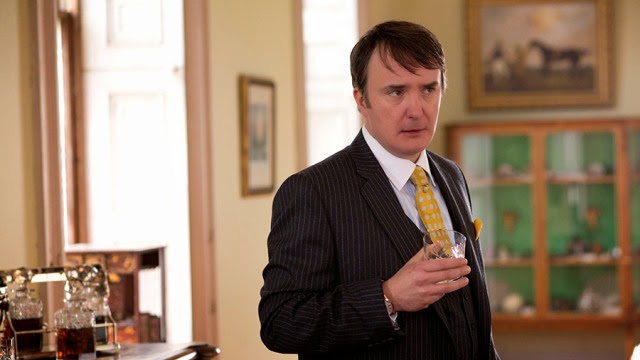
Throughout the film, Lavelle has brief meeting with the locals; some of the encounters are more troubling than others, but all of them are serious. One of the most fascinating is with a wealthy man named Michael Fitzgerald (Dylan Moran, pictured above), who lives in a well-appointed mansion in the country. He is a cynic with a flippant attitude about life; everyone in his immediate family has left him, his wife and children, even the maid. While other locals mock Father Lavelle for his religious beliefs and realize there is little he can do about their sins, this character is a rich man who is soulless; this subplot is McDonogh's commentary on recent Irish history, as bankers helped ruin the local economy, while gaining monetary wealth on their own.
Moran is superb, bringing an undeniable charm to his role; he's a louse, but given Moran's style, you almost feel sorry for him. Indeed near the end of the film, he confesses to Father Lavelle that he has a real problem and he'd like to meet with the priest. The people of Ireland, McDonagh seems to say, are adrift and have little meaning in their lives, even those who do have a bit of money.
All of this is presented amidst the spectacularly beautiful coast of County Sligo; this is a rugged land of craggy hills and rock-strewn seasides. No doubt director of photography Larry Smith will receive kudos for these shots, but his work on the entire film deserves praise. The harsh lighting of a prison, the deep primal hues of a pub and the dark blues of the inside of a church are all memorable images that Smith handles with equal aplomb. Smith was also the director of photography on McDonagh's previous film The Guard (also starring Gleeson); he knows how to bring across the message of the director's outlook in visual terms; Smith is a lensman worth remembering.

Earlier I mentioned the quality performances of Reilly and Moran; indeed the entire cast is first-rate (a tip of the cap here to McDonagh's work with his actors as well as to casting director Jina Jay). Especially memorable are Aiden Gillen (pictured above), a doctor who revels in telling Father Lavelle about the grisly details of his work; Orla O'Rourke, a married woman who flaunts her infidelities to Lavelle and David Wilmot, who portrays Father Leary, a timid soul who is no match for the flamboyance of Father Lavelle.
It is Gleeson, of course, who must carry the burden of this film, both literally and figuratively and he turns in a remarkable performance. He must be a pillar of strength, dealing with the problems of the others that inhabit his world, all the while dealing with past demons; he confesses to having loved alcohol "too much" in previous times and that history will come back to haunt him in a critical scene in the film. Gleeson is a large man - I would guess he must be at least 250 pounds, so he physically towers above everyone else in this work, but he is able to find subtle irony and humor in his everyday doings; one can imagine that he couldn't survive unless he did. He's especially moving in two scenes with troubled women: one with a visitor whose husband was killed in an accident and the other in a lovely scene - one of the few "normal" encounters in this work - during a seaside walk with his daughter. The film works on many levels, but it couldn't be believed without Gleeson's dynamic turn.
While there are a few moments of droll humor, this is basically a troubling film of souls who wander about without any real meaning in their lives. But this is a hopeful film at heart; near the end of the story, Father Lavelle says, "I think forgiveness has been highly underrated." Forgiveness, McDonagh seems to be saying, is our only salvation in this life.


